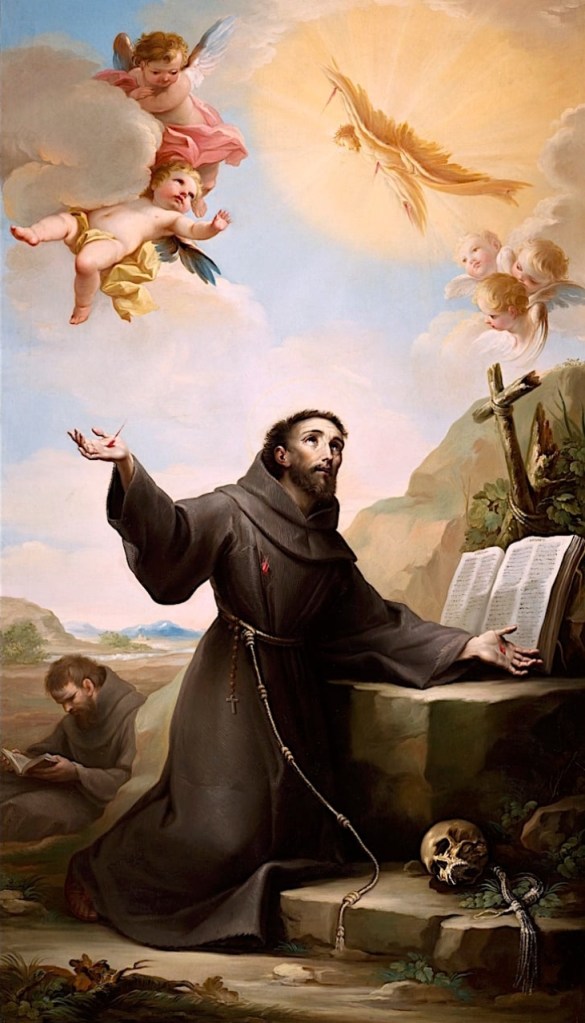
Every religious order has its specific spirit. It is the founder who, with his particular ideals, outstanding virtues, and activities gives his order its spirit. In St. Francis we see seraphic love, extreme poverty, deep humility, great penance and a chivalrous life according to the Gospel. He lived the whole Gospel fully, not only its commands, but also its precepts, ideals and implications. As his first biographer, Thomas of Celano, wrote: “He was the man with the evangelical vocation in truth and in faith the servant of the Gospel…His supreme desire, his ardent wish and his highest principle was to observe the Gospel in all things and above all things.”
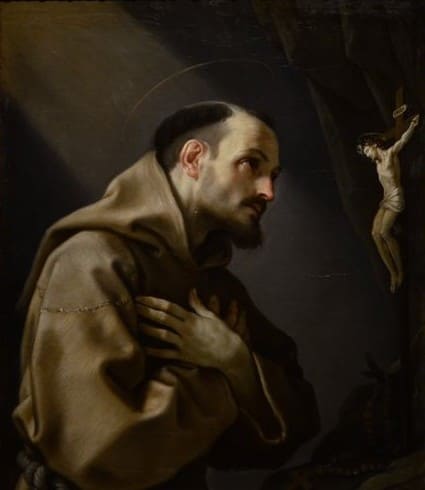
While other founders concentrated on one or another characteristic of Christ, such as zeal for souls or love of prayer, St. Francis concentrated on imitating Christ, the Divine Model, as He is pictured in the Gospel. Thus, St. Francis approached God through the Sacred Humanity of Christ. From this we see the reason for Francis’s great devotion to the Babe in the Manger, the Man of Sorrows upon the Cross, as well as the Body and Blood of Jesus Christ in the Most Blessed Sacrament. Pope Pius XI has stated that in no other saint have the image of Christ and the ideal of the Gospel been more faithfully and strikingly expressed than in Francis who has been justly styled “the second Christ” (Encyclicals Auspicato, Sacra Propediem, Rite Expiatis).
The first order of St. Francis, known as the Friars Minor, was founded in 1209. Three years later, on Palm Sunday of 1212, he and St. Clare of Assisi founded the Poor Clares, also known as the Second Order of St. Francis. In 1221, the Third Order Secular was founded by St. Francis, which Order embraces devout persons of both sexes living in the world and following a religious rule of life approved by Pope Nicholas IV in 1289 and modified by Pope Leo XIII in 1883. Eventually, some of these tertiaries began living in religious communities, which later developed into the founding of the Third Order Regular, whose members profess the religious vows of poverty, chastity, and obedience. In a Bull dated the 28th of January, 1521, Pope Leo X gave the Rule of the Third Order Regular formal approval, after which cloistered, semi-contemplative, and active communities began to spread throughout the world, greatly extending the great work of the Poverello of Assisi.
The Capuchins are a branch of the First Order of St. Francis and a reform of the Observants of the Marches, instituted in 1525 by Fr. Matteo da Bassi. Those who joined him began a reform movement which stressed the priority of contemplative prayer, more rigorous austerity, and ministering to the poor. Aiming at a more perfect return to the primitive observance of the Rule of St. Francis, in resistance to the secularizing tendency which accepted certain relaxations, Fr. Matteo sought and obtained from Pope Clement VII permission for strict adherence to the traditional rule of poverty, wearing the original Franciscan habit, and preaching the Word of God. In 1526, by Papal Brief, Fr. Matteo and two companions were exempted from the community life of the Observants, being permitted to live in hermitages. In 1528, the Capuchins were constituted a distinct and separate family, and their numbers spread rapidly. They strove to maintain simplicity and detachment, characterizing them as true sons of St. Francis. Their constitutions were approved by Pope Urban VIII in 1638. There are many saints among the Capuchins, including St. Lawrence of Brindisi (Doctor of the Church, d. 1619) and St. Veronica Giuliani (d. 1727).
In his encyclical, “Rite Expiatis,” Pope Pius XI writes very beautifully about the true spirit of St. Francis of Assisi:
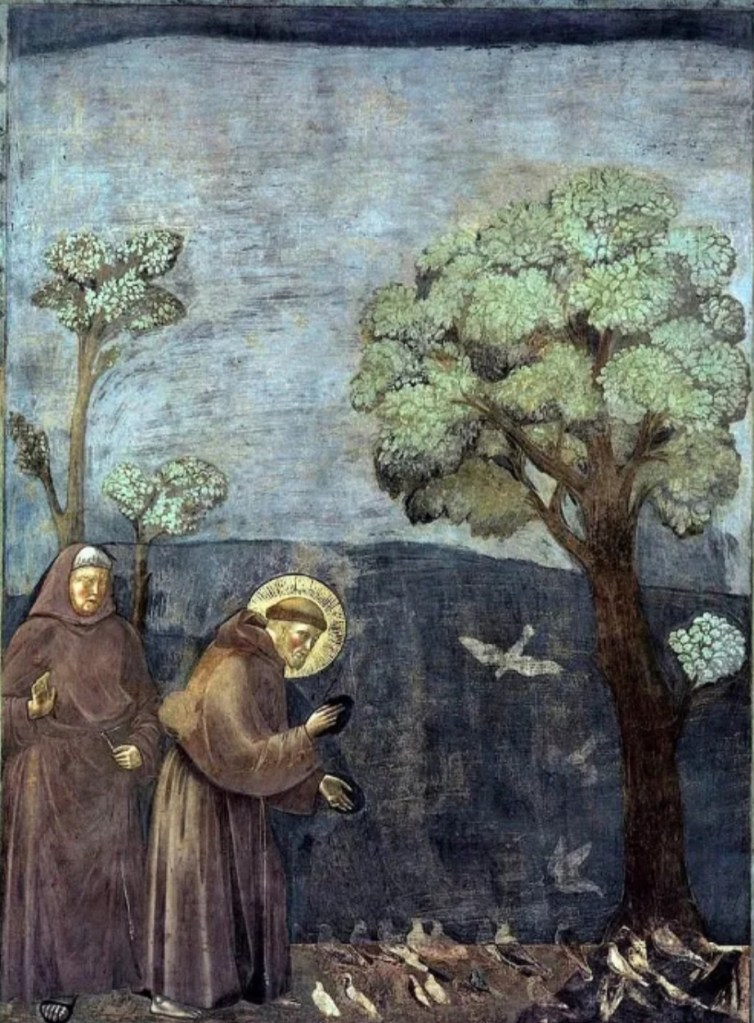
“This Saint, who was sent by Divine Providence for the reformation not only of the turbulent age in which he lived but of Christian society of all times.”
“In union with the numerous Franciscan brotherhood call to mind and praise the works, the virtues, and the spirit of the Seraphic Patriarch. While doing this, they must reject that purely imaginary figure of the Saint conjured up by the defenders of modern error or by the followers of luxury and worldly comforts, and seek to bring Christians to the faithful imitation of the ideal of sanctity which he exemplified in himself and which he learned from the purity and simplicity of the doctrines of the Gospels…”
“…It seems necessary for Us to affirm that there has never been anyone in whom the image of Jesus Christ and the evangelical manner of life shone forth more lifelike and strikingly than in St. Francis. He who called himself the “Herald of the Great King” was also rightly spoken of as “another Jesus Christ,” appearing to his contemporaries and to future generations almost as if he were the Risen Christ…”
“… After much wavering and many doubts, through divine inspiration and through having heard at solemn Mass that passage from the Gospels which speaks of the apostolic life, he understood at last that he, too, must live and serve Christ according to the very words of the Holy Gospels. From that time on, he undertook to unite himself to Christ alone and to make himself like unto Him in all things. In ‘all his efforts, public as well as private, he turned to the Cross of Our Lord, and from the moment he began to live as a soldier of Christ, the divers mysteries of the Cross shone round about him.’” (Thomas of Celano, Treatise on Miracles, No. 2)
“Among the gifts of grace which Francis received from God the generous Giver, he merited as a special privilege to grow in the riches of simplicity through his love of the highest poverty. The holy man saw that poverty was the close companion of the Son of God, and now that it was rejected by the whole world, he was eager to espouse it in everlasting love. For the sake of poverty he not only left his father and mother, but also gave away everything he had. No one was so greedy for gold as he was for poverty; nor was anyone so anxious to guard his treasure as he was in guarding this pearl of the Gospel.” (St. Bonaventure, Major Life)
“The reason why Francis particularly loved poverty was because he considered it a special virtue of the Blessed Virgin, and because Jesus Christ on the Cross even more especially chose poverty for His spouse. Since then poverty has been forgotten by men and has appeared to the world both irksome and foreign to the spirit of the age.”
“St. Francis, following the example and words of Christ (Matt. xx, 26, 28; Luke xxii, 26), considered humility in his followers as the distinctive mark of his Order. Namely, ‘he insisted that his disciples be called ‘Minors,’ and the superiors of his Order ‘Ministers.’He did this in order both to make use of the very language of the Gospels which he had promised to observe and to make his disciples understand by the name which they bore that they must go to the school of the humble Christ in order to learn humility.’” (St.Bonaventure, Major Legend Ch. 6. No. 5)
“As a man who was truly Catholic and apostolic, he insisted above all things in his sermons that the faith of the Holy Roman Church should always be preserved inviolably, and that the priests who by their ministry bring into being the sublime Sacrament of the Lord, should therefore be held in the highest reverence.”
“We must speak also of the “beauty and cleanliness of purity” which the Seraphic Father “loved singularly,” of that chastity of soul and body which he kept and defended even to the maceration of his own flesh. We have already seen that as a young man, although gay and fashionable, he abhorred everything sinful, even in word. When later on he cast aside the vain pleasures of this world, he began to repress the demands of his senses with great severity. Thus at times when he found himself moved or likely to be influenced by sensual feeling, he did not hesitate to throw himself into a bush of thorns or, in the very depths of winter, to plunge into the icy waters of a stream.”
“St. Francis, trained in the manly virtues We have written about, was called providentially to a work of reform for the salvation of his contemporaries and to assist in the work of the Church Universal.”
“As a matter of fact, by his practice of all the virtues in a heroic manner, by the austerity of his life and his preaching of penance, by his manifold and restless activity for the reformation of society, the figure of Francis stands forth in all its completeness, proposed to us not so much for the admiration as for the imitation of Christian peoples. As the Herald of the Great King, his purposes were directed to persuading men to conform their lives to the dictates of evangelical sanctity and to the love of the Cross.”