Ave Maria! We pray you are all in the midst of a very holy and grace-filled season of Advent. Work continues on our little convent chapel. We hope to have it ready within the next two weeks so that we may welcome the Infant Jesus, our God and Spouse, into our hearts, our souls, and our tabernacle at Christmas. What a joyful Christmas it will be to dwell with the King of Heaven!
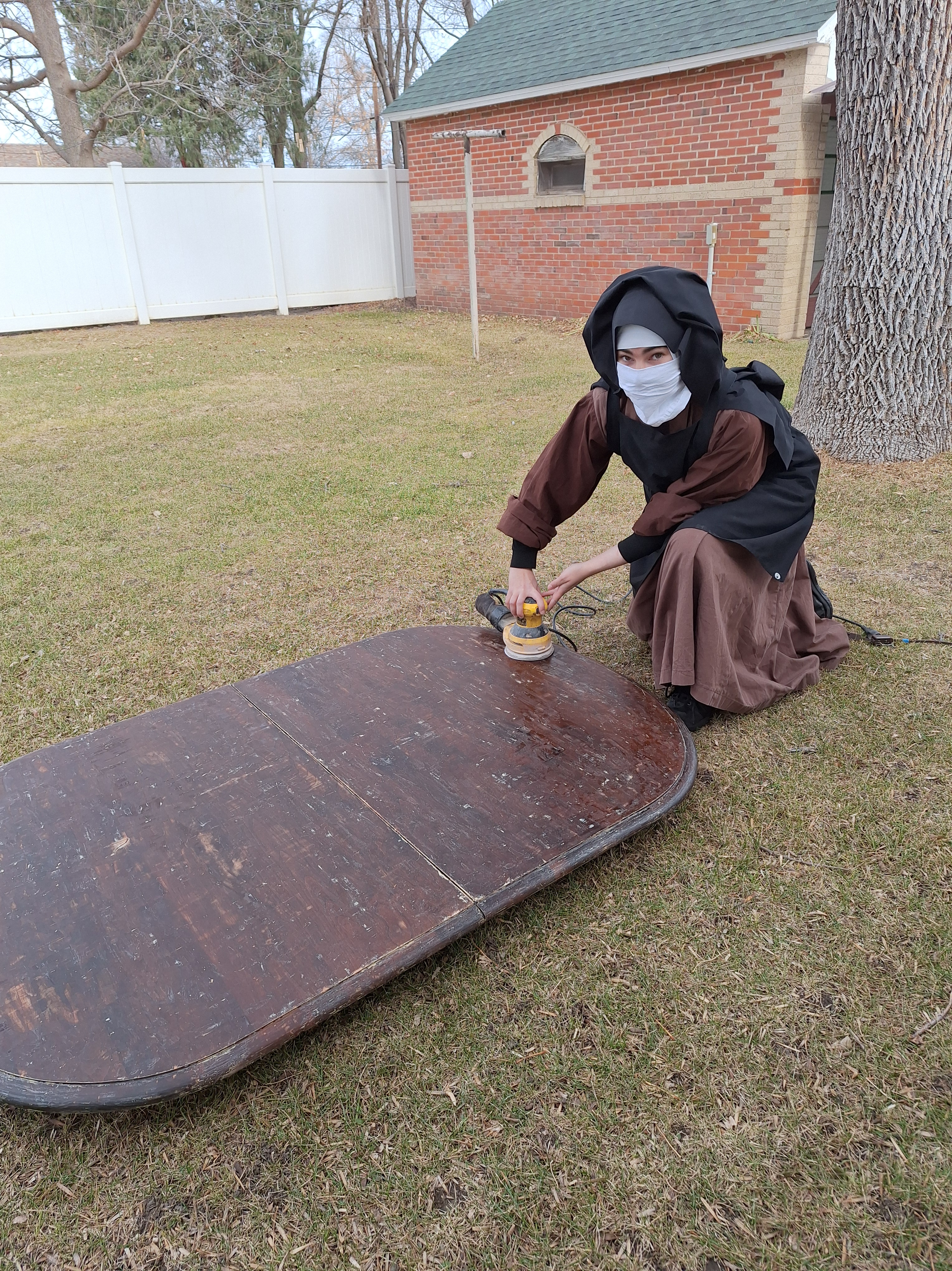
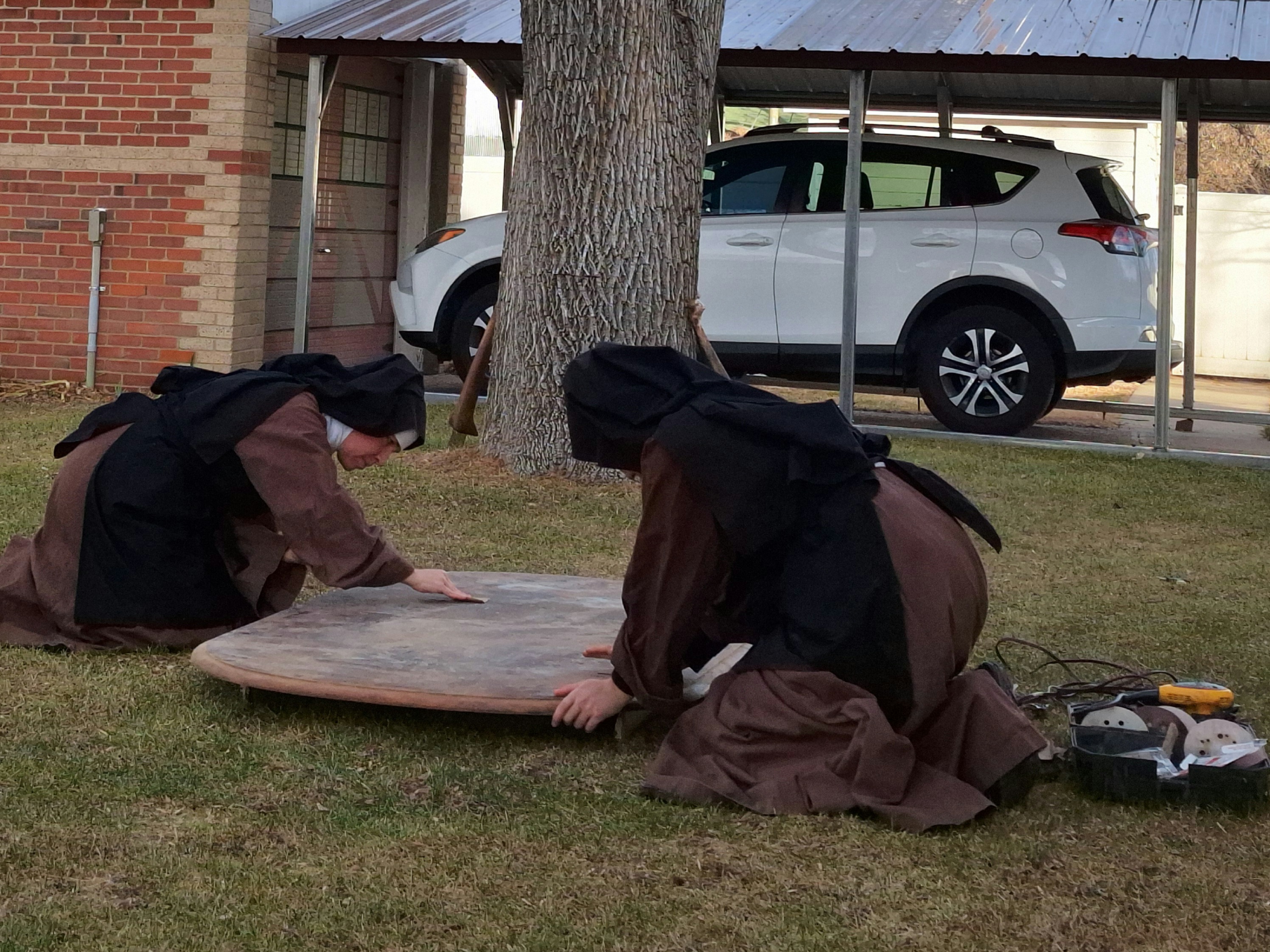
We now have a “Sister Carpenter”, who frequently calls upon St. Joseph to help her with work she never imagined herself doing in the convent: stripping and refinishing old wood, constructing chairs and kneelers, and learning the names of various tools and how they work. The early Franciscans, embracing Lady Poverty with great jealousy, worked in this same fashion, and we are learning just how spoiled we are in the modern world. While we are unable, due to small numbers in our beginning stages, to do everything by the labor of our own hands, we are attempting to do what we can.
We are now also experiencing our first true Winter in Colorado. Coming from Texas, this has been very…well…cold! We laugh at our frailty and remind ourselves that the elements provide plenty of opportunity to save souls if we remain in the presence of God and keep always in front of us the reason we consecrated our lives to God. We give others plenty of opportunity to save souls too when they are forced to drive in the snow behind the nuns with the Texas license plate!
Our appeal for your help continues, as we are now beginning to receive correspondence from young ladies around the country, and we have no room to receive them. We are praying a perpetual novena to St. Joseph to provide a permanent home where our foundation may grow and where we may truly live according to the spirit of St. Francis and our Capuchin customs. We live in a world that no longer understands religious life and the necessity of consecrated souls to pray and sacrifice for the conversion and salvation of sinners, for our country, for our world, and for the triumph of the Holy Catholic Church against her enemies within and without. We rely solely upon Divine Providence and the generosity of the faithful in order to live. We thank all of you for your generous support, and we assure you that we carry each and every one of you, with all of your intentions, in all of our prayers and sacrifices. In every Mass and at every holy Communion and, since we have a special claim on the Heart of Our Lord, we trust in Him with great confidence to repay you all the promised hundred-fold in this life and in eternity.
May God bless you, and may Our Lady keep you close to her Immaculate Heart!
The Capuchin Sisters of St. Joseph
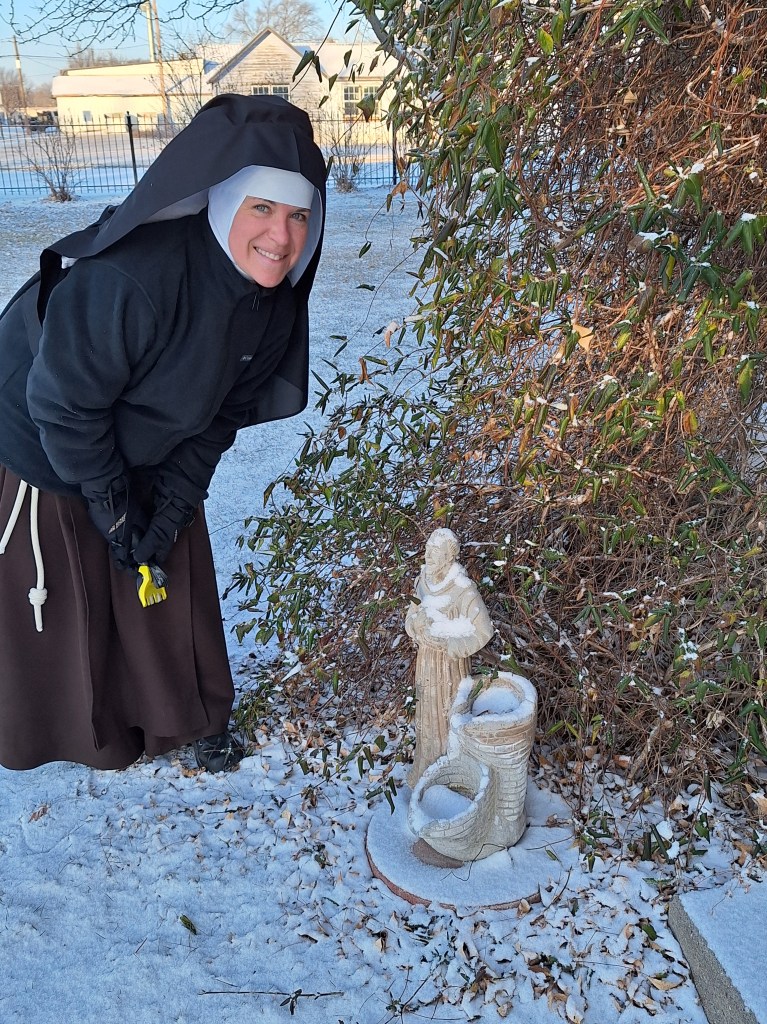
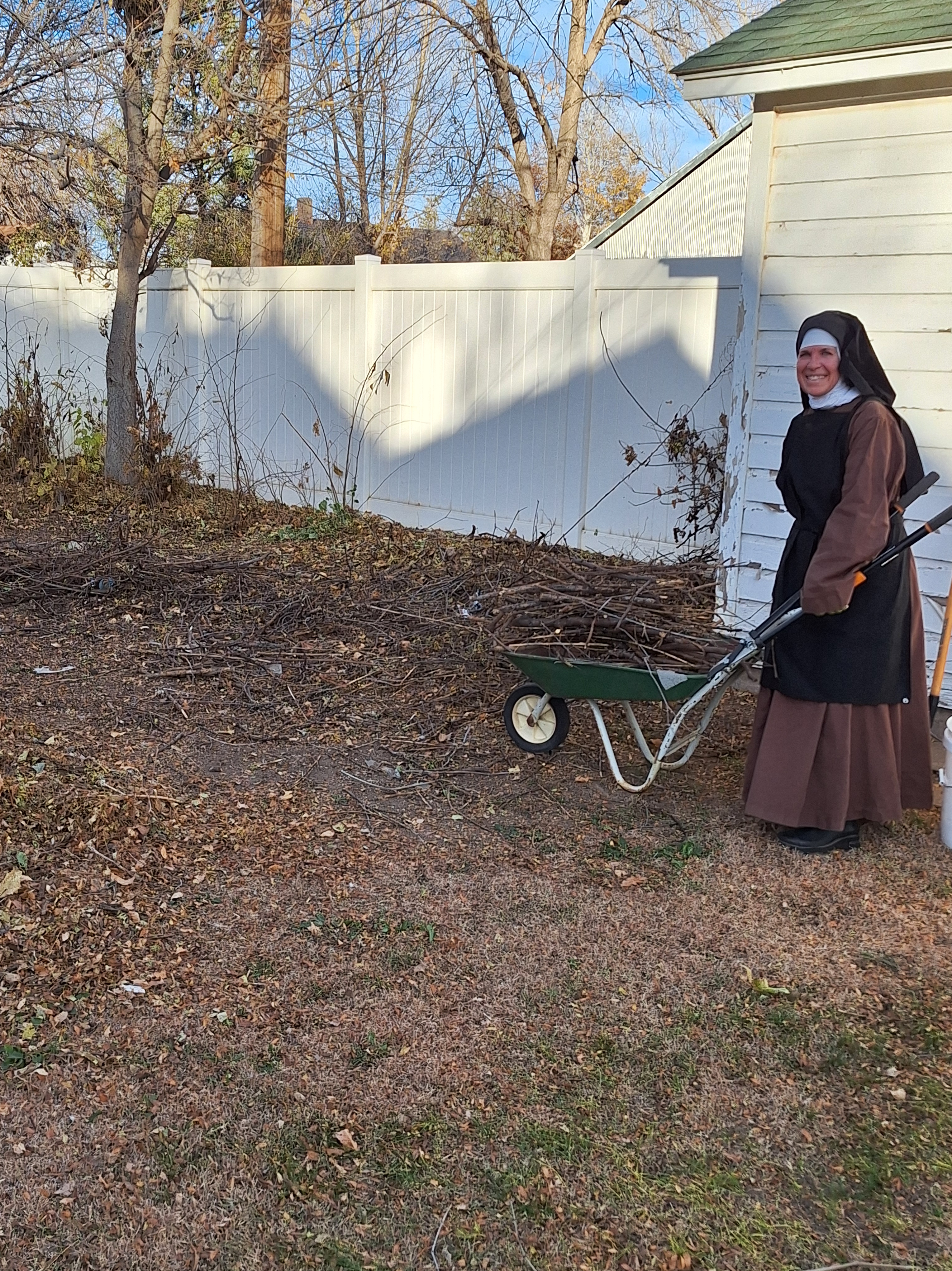
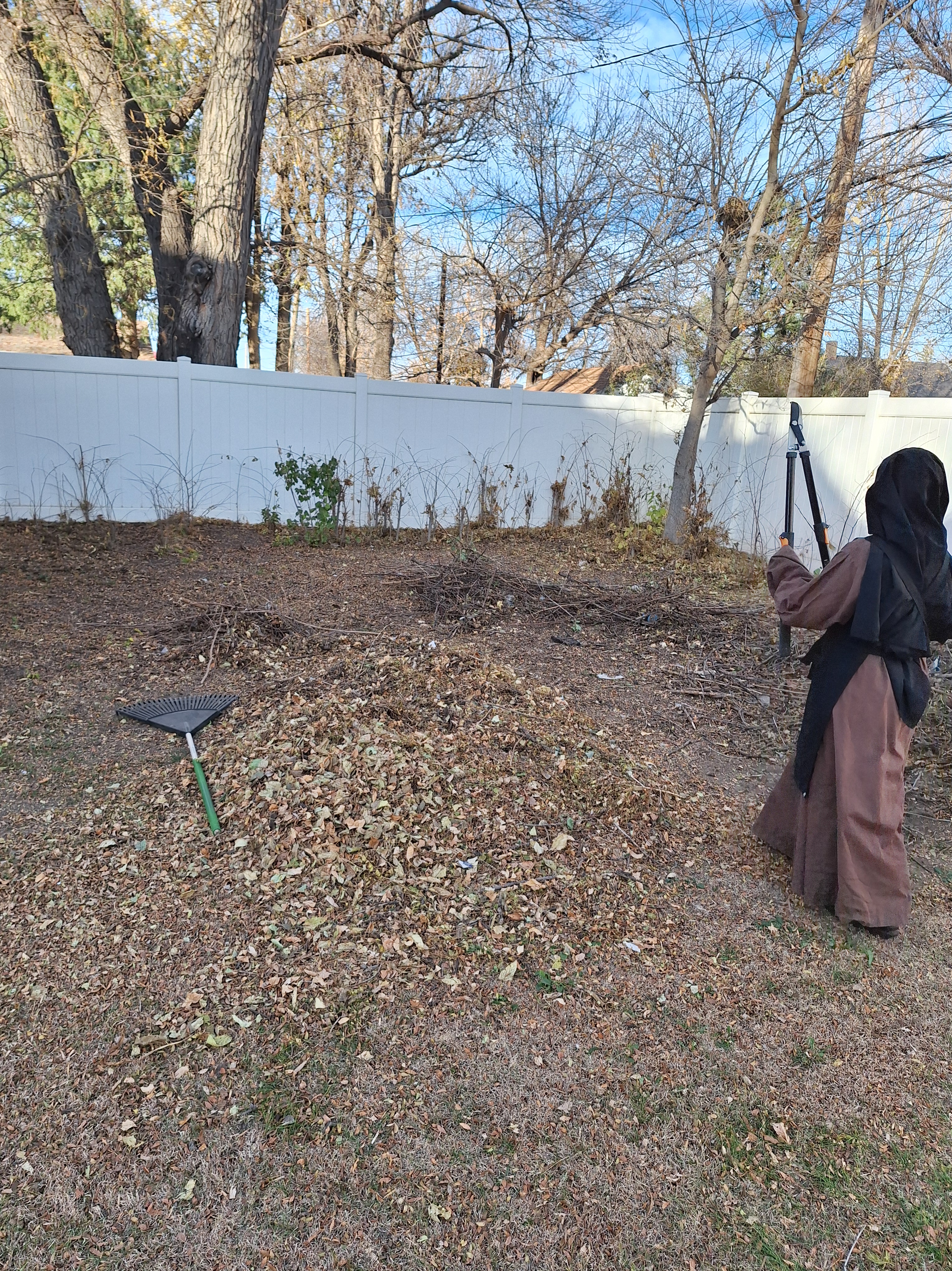
Before the snowfall, the Sisters work to clear an area for Our Lady’s spring grotto.
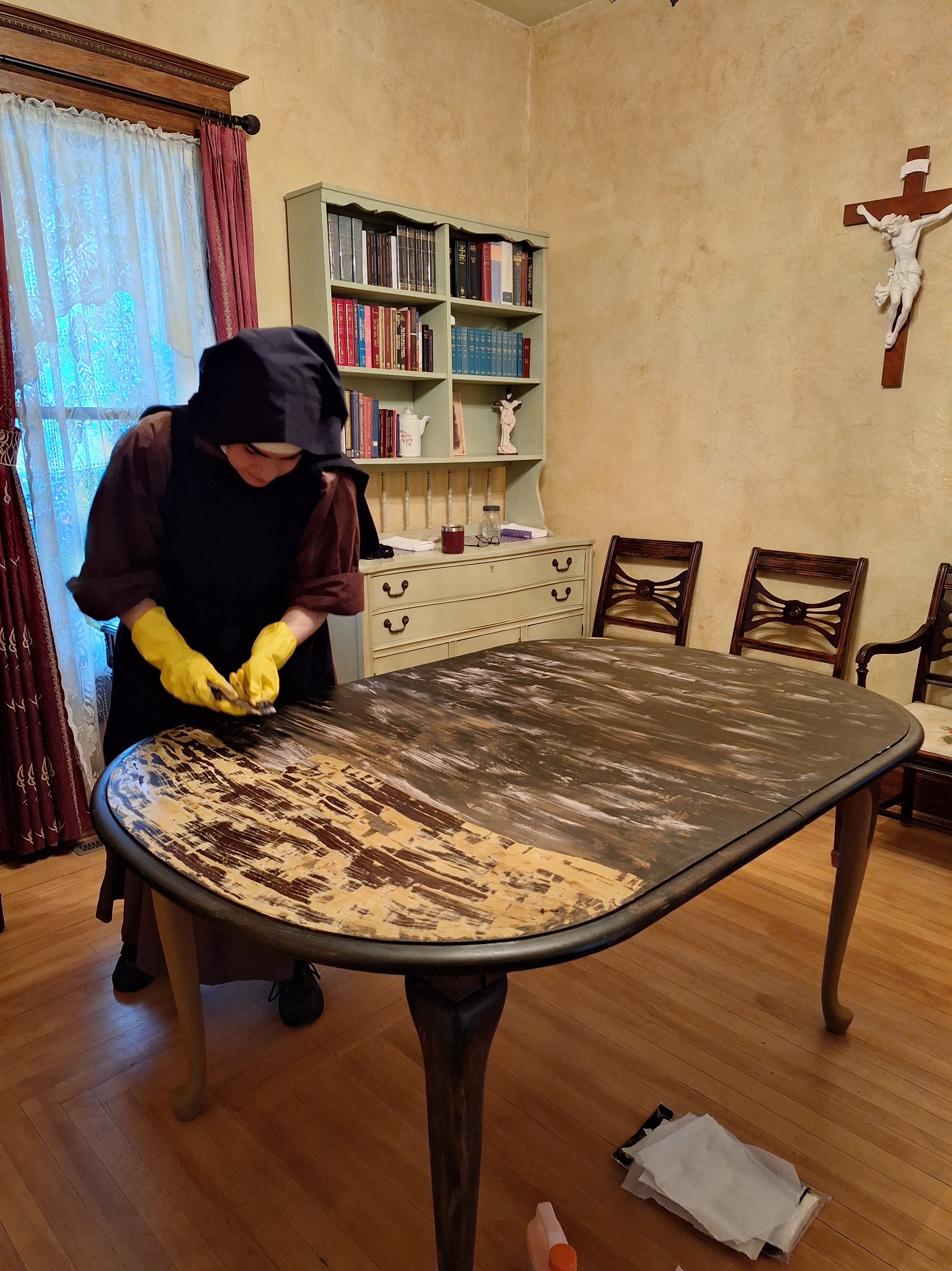
Our first attempt at refurbishing an old table
We quickly discovered it was an outdoor job….
When power tools failed, we discovered it was a two person job!
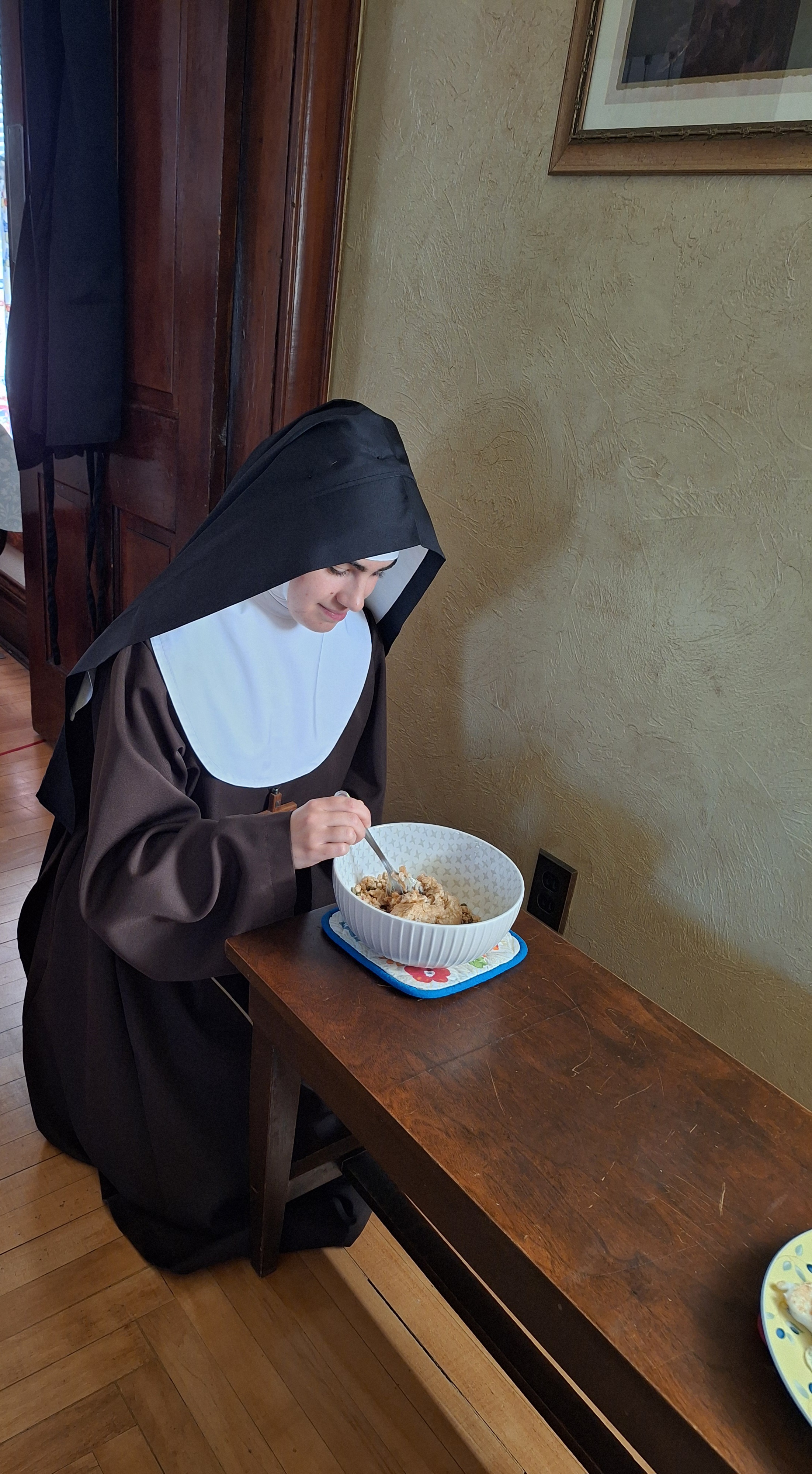
One of our Capuchin customs is to kneel for collations during Advent.
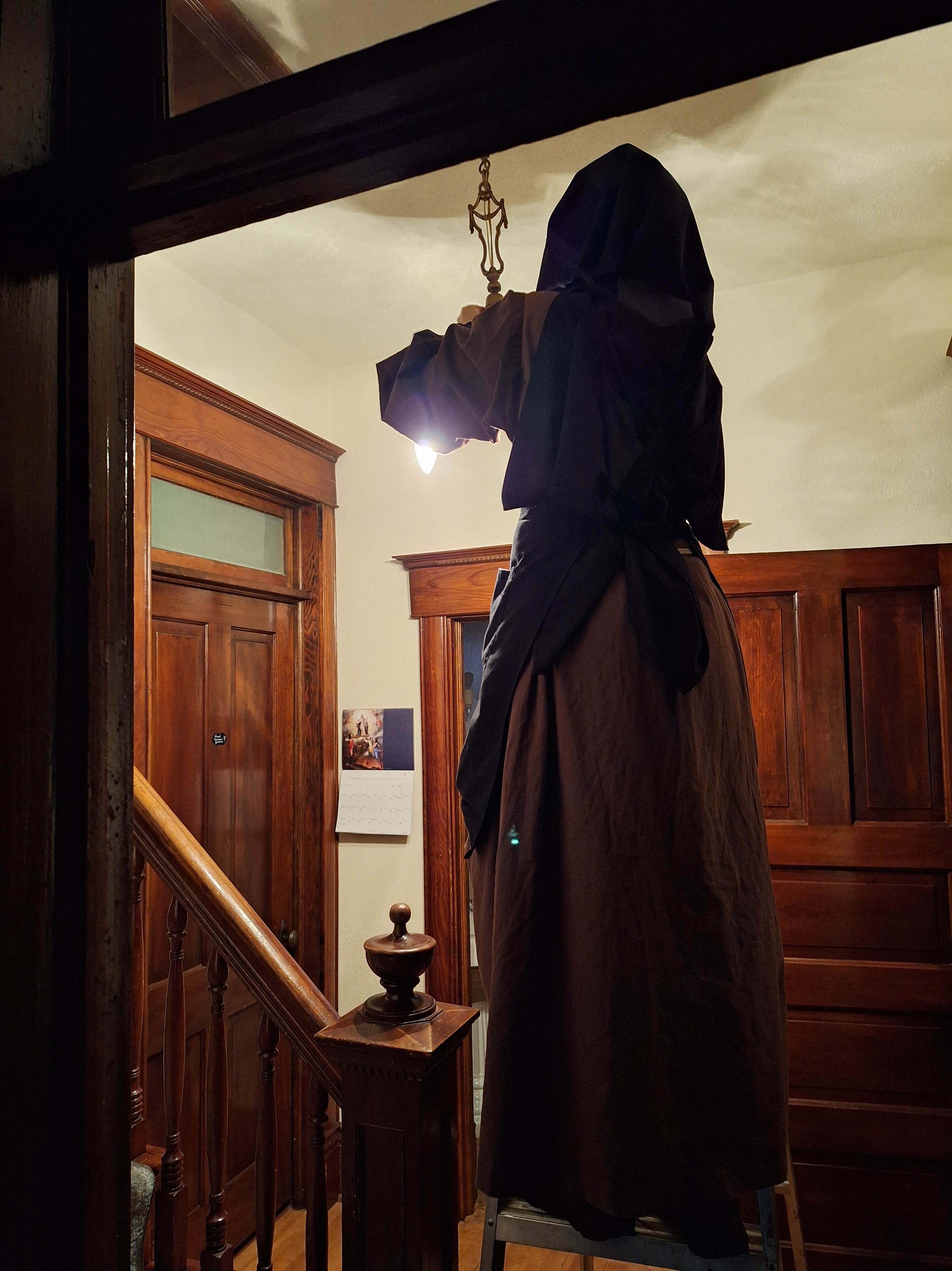
The Sisters are learning many trades, including electrical work.
Pax et Bonum! We pray you are all well and that this update finds you in the midst of a grace-filled month of the Immaculate Heart of Mary! This month is an especially joyful one for the Franciscan Order. In addition to the two great feasts of our Blessed Mother, the Assumption and the Immaculate Heart of Mary, we will also celebrate the feast of our patroness, St. Clare of Assisi, on August 12th. Be assured that we will keep each and every one of you in the heart of our prayers and at holy Mass most especially on that day, asking St. Clare to bless you for your support which has helped make it possible for us to consecrate our lives to God alone.
Recently, we have happened upon some very beautiful resources for the Third Order Secular. It is our great hope to post these treasures to our website so that our Tertiary Brothers and Sisters will have access to them. Please pray that Lady Poverty, who also embraces “free time” in the convent, will permit us to accomplish this little work. Pope Leo XIII, in his encyclical, Auspicato Concessum, wrote: “…it has been long and specially Our desire that everyone should, to the utmost of his power, aim at imitating St. Francis of Assisi…We exhort Christian men not to refuse to enroll themselves in this sacred army of Jesus Christ.” The severe lack of an authentically Catholic spirit, centered around prayer and mortification, is the predominant reality of our age. Our Lord Jesus Christ called St. Francis to help rebuild His Church which was, in that time, falling into ruin. What could be said about the Church today during this state of world-wide apostasy?
More than ever, the Church needs men and women in all states of life who pray, sacrifice, and practice heroic virtue. Franciscan Tertiaries consecrate their secular state and enter a nobler company of the Church Militant. They promise to observe a rule, compatible to their state in life, which helps them to detach from the spirit of the world, renounce vice, and acquire virtue, leading many souls towards salvation by their good example. It is truly a religious life within the reach of all faithful Catholics. If you are not a member of the Third Order and wish to learn more, we would be very happy to provide you with more information.
Finally, we once again appeal to your charity. We are finally settled in our temporary convent in Colorado. While it has been very generously loaned to us indefinitely, it is necessary that we purchase something permanent. God willing, we will have as many as three young ladies visiting us this Fall in order to discern their vocations. Since Franciscans are mendicants, we rely solely upon Divine Providence and the generosity of benefactors for our daily bread and sustenance. At present, our need for a house is pressing. If you or anyone you know may be able to help us with a tax free donation, we will be eternally grateful. Directions for donations may be on our website donate link. Prayers are the most important form of charity, and we continue to beg those in abundance. We trust that Almighty God, Who is never outdone in generosity, may bless you with the promised hundred-fold now and in eternity.
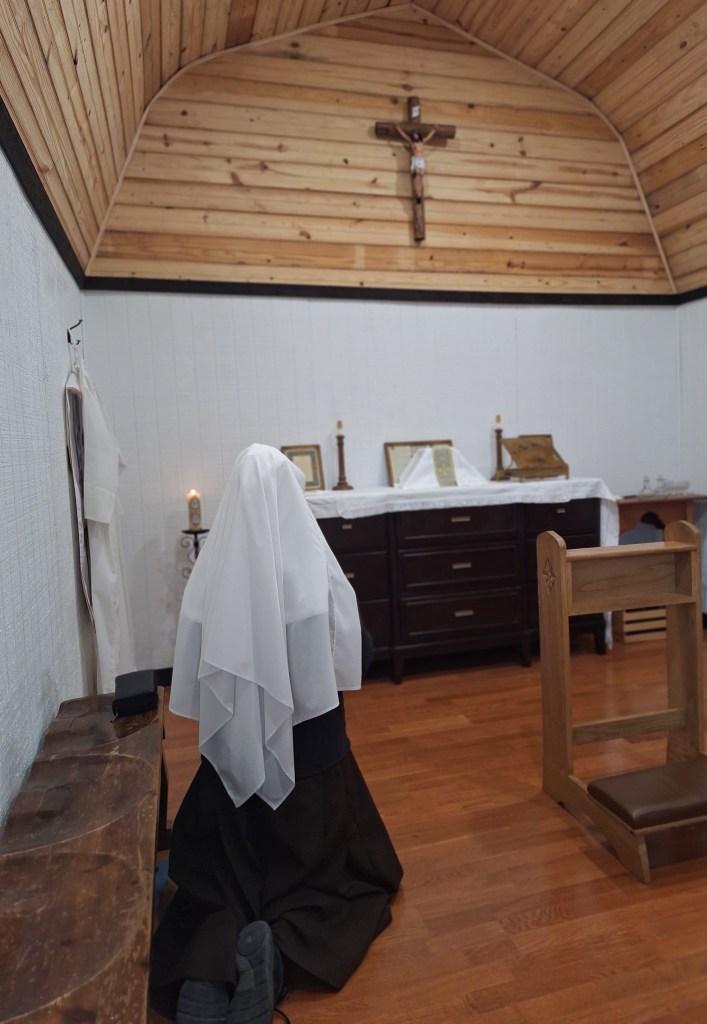
As we continue in the month of the Precious Blood, we wish to reassure each of you of your continued place in the heart of our prayers. How much we have to be grateful for in our temporary home in Colorado! For the first two years of our community, we were without a chapel except on Sundays. Far from hindering us from the practice of mental prayer and our spiritual exercises, it ignited a longing in our hearts and souls to be in the presence of our Divine Spouse before the tabernacle. During the third year of our foundation, the benefactors who provided our housing built a little chapel on their property. While we still lacked the True Presence, we were one step closer. This little chapel, “Our Lady of the Angels,” will always be very special to us. Here in Burlington, thanks be to God, our longings have been fulfilled above and beyond measure. Although it is only temporary, until our heavenly Father provides a permanent place for us, we count ourselves as the richest of the rich, as we have everything and All here in the tabernacle.
We have included with this post a short instruction on mental prayer, which has been simplified in order that, God willing, it may be of help to those who have asked for it. St. Teresa of Avila once said that no one who earnestly applies themselves to mental prayer will be lost. It was the practice of the saints, and it is in our Rule here in the convent to begin and end each day with half an hour in mental prayer.
We continue to beg for your charity in helping us to raise the necessary funds for a permanent home. Information can be found on our “Donate” link. We ask God to bless you with His promised hundredfold now and in eternity.
In the Hearts of Jesus and Mary,
Capuchin Sisters of St. Joseph
MENTAL PRAYER
All Catholics should make at least a short meditation every day. Mental prayer is a more appropriate and comprehensive term for that spiritual exercise which is so highly praised and commended by the saints and so conducive to holiness and perfection.
Mental prayer is within the reach of all who earnestly desire their salvation. In mental prayer, meditation, which is the exercise of the intellect, is only a means to the end. This end is the elevation of the soul to God or, if you will, conversation with God. While thinking and reflecting, the soul speaks to and reasons with itself. However, in the prayer that follows, the soul speaks to God.
“In mental prayer,” says St. Alphonsus, “meditation is the needle, which only passes through that it may draw after it the golden thread, which is composed of affections, resolutions, and petitions.” As soon as you feel an impulse to pray while meditating, give way to it at once in the best way you can by devout acts and petitions; in other words, begin your conversation with God on the subject about which you have been thinking.
In order to help the mind in this pious exercise, you must have some definite subject of thought upon which it is well to read either a text of Holy Scripture or a few lines out of some other holy book. Any point on the Passion of Our Lord will provide ample material for this practice.
St. Alphonsus says, “It is good to meditate upon the last things – death, judgment, eternity – but let us above all meditate upon the Passion of Christ.”
St. Teresa of Avila tells us that in her meditations she helped herself with a book for seventeen years. By reading the points of a meditation from a book, the mind is rendered attentive and is set on a train of thought. Further to help the mind, you can ask yourself some such questions as the following: What does this mean? What lesson does it teach me? What has been my conduct regarding this matter? What have I done, what shall I do, and how shall I do it? What particular virtue must I practice?
Do not imagine, moreover, that it is necessary to wait for a great fire to flame up in your soul, but cherish even the smallest spark you may have. Above all, never give way to the mistaken notion that you must restrain yourself from prayer in order to go through all of the thoughts suggested by your book, or because your prayer does not appear to have a close connection with the subject of your meditation. This would simply be to turn from God to your own thoughts or to the thoughts of another.
To meditate means, in general, nothing other than to reflect seriously upon some subject. Meditation, as mental prayer, is a serious reflection on some religious truth or event, with reference and application to ourselves, in order thereby to excite in us certain pious sentiments, such as contrition, humility, faith, hope, charity, etc., and to move our will to form good resolutions conformable to these pious sentiments. Such an exercise has a beneficial influence on our soul and greatly conduces to enlighten our mind and to move our will to practice virtue.
Meditation is a great means to salvation. It helps us to know ourselves and to discover the means of avoiding and correcting our vices, our faults, and weaknesses; it reveals to us the dangers to which our salvation is exposed and leads us to pray with a contrite and humble heart for the necessary graces to cope with temptations, to control our passions, and to lead a holy life. Mental prayer inflames our hearts with the love of God and strengthens us to do His holy will with zeal and perseverance.
We should endeavor to spend at least fifteen minutes daily in mental prayer. The saints used to spend many hours daily therein. When they had much to do, they would subtract some hours from the time allotted to their sleep in order to devote themselves to this holy exercise. If we cannot spend half an hour every day in this practice, let us at least devote to it a quarter of an hour. The longer and the more fervent our mental prayer, the more we shall enjoy it, and we shall learn by our own experience the truth of the saying of the Royal Prophet, “Taste and see that the Lord is sweet” (Ps. xxxiii. 9).
As to our petitions and resolutions, in mental prayer it is very profitable, and perhaps more useful than any other act, to address repeated petitions to God, asking with great humility and unbounded confidence for His graces, for virtues and, above all, for the inestimable gift of His holy love. If we feel dry or despondent and unable to meditate or pray well, let us repeat many times as earnestly as possible, “My Jesus, mercy!”, “My God, I love Thee!” or any ejaculatory prayer. This will be very meritorious.
Let us offer all our petitions for grace in the Name and through the merits of Jesus Christ, and we shall surely obtain all that we ask.
Before concluding the meditation, we should make some specified good resolution, appropriate as far as possible to the subject of our meditation. This resolution should be directed to rooting out of a particular sin, or of some occasion of sin, to the correction of some defect, or to the practice of some act of virtue during the day.
The preparation of our meditation consists of (1) an act of faith in the presence of God, and of adoration; (2) an act of humility and of contrition, and (3) an act of petition for light. We should then recommend ourselves to the Blessed Virgin Mary by reciting a Hail Mary, and also to St. Joseph, to our Guardian Angel, and to our holy patrons. These acts should be brief but very fervent.
The conclusion of our meditation consists of (1) thanksgiving to God for the light He imparted to us; (2) purposing to fulfill our good resolutions at once; and (3) beseeching the eternal Father, for the love of Jesus and Mary, to grant us the grace and strength to put them into practice. Before finishing our meditation, let us never omit to recommend to God the souls in purgatory and poor sinners.
Pax et bonum! At long last, we have arrived to Burlington, Colorado, and the next chapter in our community life begins. We marvel at Divine Providence and the loving care of our Heavenly Father, Who continues to provide for us in ways beyond all human expectation. Like our seraphic father, St. Francis, our beginnings were very meager. In fact, we started out in a small 15′ x 15′ space. From there, a very generous family offered a 450 square foot apartment on their property, which we fondly called our “Rivo Torto”, after the little ruined building where St. Francis and his first followers began their community life and from whence many blessings flowed for the founding of the Order. We were very happy in this little place!
However, our constant prayer has been that we may be near daily Mass in order to take our longed-for place before the tabernacle and receive our Divine Spouse in Holy Communion daily. Our congregation prays a perpetual novena to St. Joseph and to Our Lady of Prompt Succor. Both have refused us nothing that has been for the good of our congregation. Quite spontaneously, a generous benefactor has offered the use of a home less than two blocks from the Church and our Father Director. Needless to say, words fail to express our heartfelt gratitude towards all of the good souls whose generosity and sacrifice have made our life possible. While words fail us, we confidently look to our loving Father in heaven to repay each of them the promised hundredfold in this life and in eternity.
We continue to beg the charity of your prayers and for your support, as three young ladies prepare to visit in order to discern their vocations. We continue to work towards the goal of a permanent convent to house the vocations God may send to us. We ask your prayers for our fidelity and perseverance, and we assure you of a constant place in the heart of our prayers. May God bless and keep you!
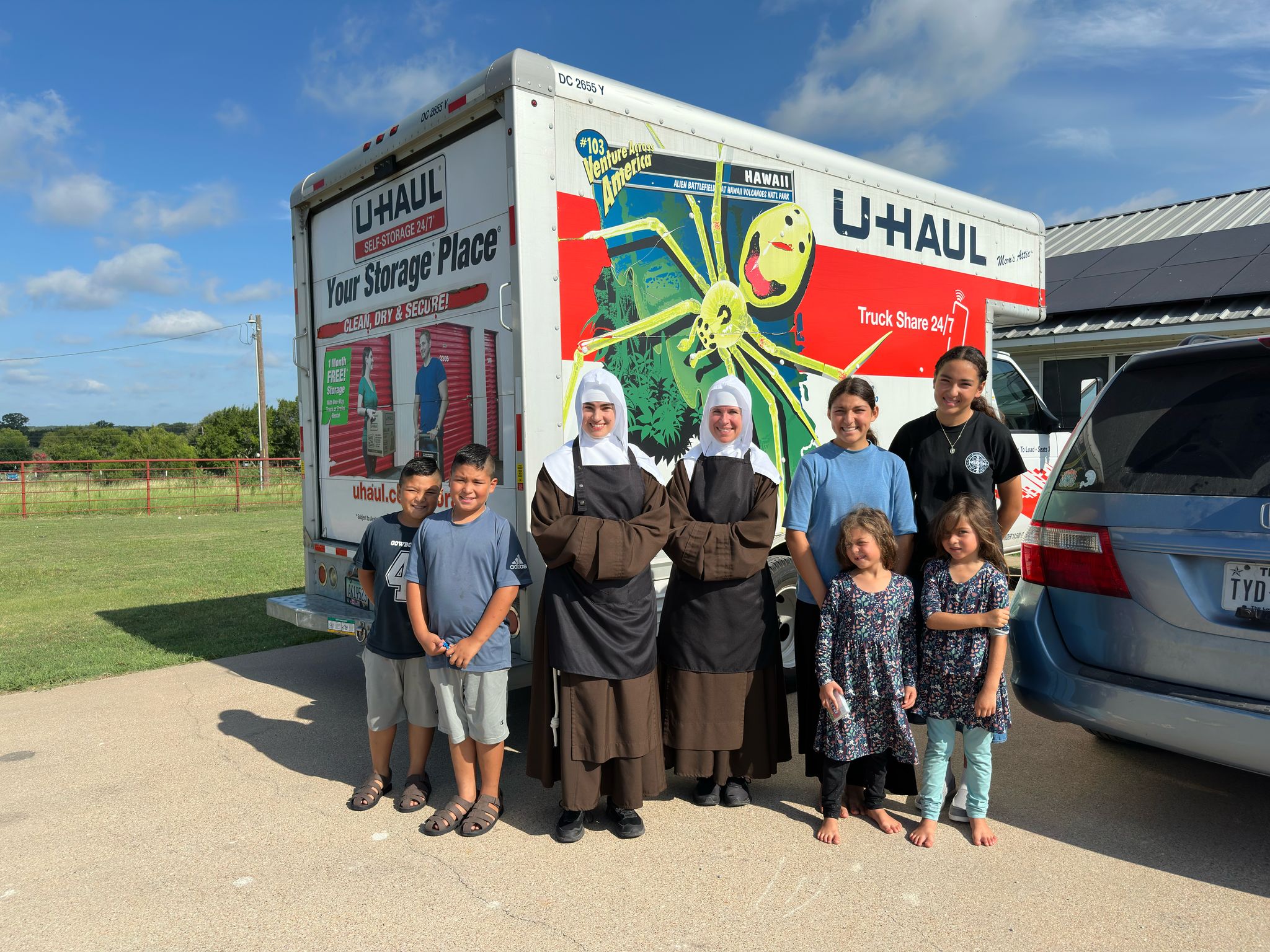
Arrival at the house in Burlington. It was our first experience driving a U-Haul truck… Thank you, guardian angels for guiding us safely to port!
The school children gathered for one last picture before we set off.
A little rabbit has taken up residence in the flower garden. St. Francis loved God’s little creatures, who always do the will of God, and we take great joy in them too.
One of the apostolates of our congregation is the doctrinal formation of children in order to prepare them for the combat they must surely face in this life. In order for this formation to bear fruit, it is necessary that parents understand the gravity of their duty towards the eternal souls of their children and the account they will render to God.
Advice to Parents
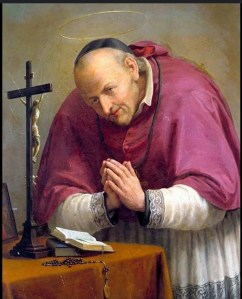
by Saint Alphonsus Liguori (1696-1787)
Saint Alphonsus, founder of the Redemptorist Order, Bishop and Doctor of the Church, expounds on the privilege and grave responsibilities of parents.
The gospel tells us that a good plant cannot produce bad fruit and that a bad one cannot produce good fruit. We learn from this that a good father brings up good children. But, if the parents are wicked, how can the children be virtuous? Our Lord says, in the same gospel, Do men gather grapes from thorns, or figs from thistles? (Matt. 7:16). So, it is impossible, or rather very difficult, to find children virtuous, who are brought up by immoral parents. Fathers and mothers, be attentive to this sermon, which is of great importance to the eternal salvation of yourselves and of your children. Be attentive, young men and young women who have not as yet chosen a state in life. If you wish to marry, learn the obligations which you contract with regard to the education of your children, and learn also, that if you do not fulfill them, you shall bring yourselves and all your children to damnation. I shall divide this into two points. In the first, I shall show how important it is to bring up children in habits of virtue; and, in the second, I shall show with what care and diligence a parent ought to labor to bring them up well.
A father owes two obligations to his children; he is bound to provide for their corporal wants, and to educate them in the habits of virtue. It is not necessary to say anything else about the first obligation, than, there are some fathers more cruel than the most ferocious of wild beasts, for these squander away in eating, drinking, and pleasure, all their property, or all the fruits of their industry, and allow their children to die of hunger. Let us discuss education, which is the subject of this article.
It is certain that a child’s future good or bad conduct depends on his being brought up well or poorly. Nature itself teaches every parent to attend to the education of his offspring. God gives children to parents, not that they may assist the family, but that they may be brought up in the fear of God, and be directed in the way of eternal salvation. “We have,” says Saint John Chrysostom, “a great deposit in children, let us attend to them with great care.” Children have not been given to parents as a present, which they may dispose of as they please, but as a trust, for which, if lost through their negligence; they must render an account to God.
One of the great Fathers says that on the day of judgment, parents will have to render an account for all the sins of their children. So, he who teaches his son to live well, shall die a happy and tranquil death. He that teaches his son…when he died, he was not sorrowful, neither was he confounded before his enemies (Eccl. 30: 3,5). And he will save his soul by means of his children, that is, by the virtuous education which he has given them. She shall be saved through childbearing (I Tim. 2:15).
But, on the other hand, a very uneasy and unhappy death will be the lot of those who have labored only to increase the possessions, or to multiply the honors of their family, or who have sought only to lead a life of ease and pleasure, but have not watched over the morals of their children. Saint Paul says that such parents are worse than infidels. But if any man have not care of his own, and especially of those of his house, he has denied the faith, and is worse than an infidel (I Tim. 5:8).
Were fathers or mothers to lead a life of piety and continual prayer, and to communicate every day, they should be damned if they neglected the care of their children.
If all fathers fulfilled their duty of watching over the education of their children, we should have but few crimes. By the bad education which parents give to their offspring, they cause their children, says Saint John Chrysostom, to rush into many grievous vices; and thus they deliver them up to the hands of the executioner. So it was, in one town, a parent, who was the cause of all the irregularities of his children, was justly punished for his crimes with greater severity than the children themselves. Great indeed is the misfortune of the child that has vicious parents, who are incapable of bringing up their children in the fear of God, and who, when they see their children engage in dangerous friendships and in quarrels, instead of correcting and chastising them, they take compassion on them, and say, “What can I do? They are young; hopefully they will grow out of it.” What wicked words, what a cruel education! Do you hope that when your children grow up, they will become saints? Listen to what Solomon says, “A young man, according to his way, even when he is old, he will not depart from it” (Proverbs 22:6). A young man who has contracted a habit of sin, will not abandon it even in his old age. His bones, says holy Job, will be filled with the vices of his youth, and they will sleep with him in the dust (Job 20:11). When a young person has lived in evil habits, his bones will be filled with the vices of his youth, so that he will carry them to the grave, and the impurities, blasphemies, and hatred to which he was accustomed in his youth, will accompany him to the grave, and will sleep with him after his bones are reduced to dust and ashes. It is very easy, when they are small, to train children to habits of virtue, but, when they have come to manhood, it is equally difficult to correct them, if they have learned habits of vice.
Let us come to the second point, that is, to the means of bringing up children in the practice of virtue. I beg you, fathers and mothers, to remember what I now say to you, from on it depends the eternal salvation of your own souls, and of the souls of your children.
Saint Paul teaches sufficiently, in a few words, in what the proper education of children consists. He says that it consists in discipline and correction. And you, fathers, provoke not your children to anger, but bring them up in the discipline and correction of the Lord (Ephes. 5:4). Discipline, which is the same as the religious regulation of the morals of children, implies an obligation of educating them in habits of virtue by word and example. First, by words: a good father should often assemble his children, and instill into them the holy fear of God. It was in this manner that Tobias brought up his little son. The father taught him from his childhood to fear the Lord and to fly from sin. And from infancy he taught him to fear God and abstain from sin (Tobias 1:10). The wise man says, that a well educated son is the support and consolation of his father. Instruct your son, and he will refresh you, and will give delight to your soul (Prov. 29:17). But, as a well instructed son is the delight of his father’s soul, so an ignorant child is a source of sorrow to a father’s heart, for the ignorance of his obligations as a Christian is always accompanied with a bad life.
It was related that, in the year 1248, an ignorant priest was commanded, in a certain synod, to make a discourse. He was greatly agitated by the command and the Devil appearing to him, instructed him to say, “The rectors of infernal darkness salute the rectors of parishes, and thank them for their negligence in instructing the people; because from ignorance proceeds the misconduct and the damnation of many.”
The same is true of negligent parents. In the first place, a parent ought to instruct his children in the truths of the Faith, and particularly in the four principle mysteries. First, that there is but One God, the Creator and Lord of all things; secondly, that this God is a remunerator, Who, in the next life, will reward the good with the eternal glory of Paradise, and will punish the wicked with the everlasting torments of Hell; thirdly, the mystery of the Most Holy Trinity, that is, that in God there are Three Persons, Who are only One God, because They have but One Essence; fourthly, the mystery of the Incarnation of the Divine Word, the Son of God, and True God, Who became man in the womb of Mary, and suffered and died for our salvation.
Should a father or mother say, “I myself do not know these mysteries,” can such an excuse be admitted? Can one sin excuse another? If you are ignorant of these mysteries, you are obliged to learn them, and afterwards to teach them to your children. At least, send your children to a worthy catechist. What a miserable thing to see so many fathers and mothers, who are unable to instruct their children in the most necessary truths of the Faith, and who, instead of sending their sons and daughters to Christian doctrine, employ them in occupations of little account, and when they are grown up, they do not know what is meant by mortal sin, by Hell, or eternity. They do not even know the Creed, the Our Father, or the Hail Mary, which every Christian is bound to learn under pain of mortal sin.
Religious parents not only instruct their children in these things, which are the most important, but they also teach them the acts which ought to be made every morning after rising. They teach them first, to thank God for having preserved their life during the night, secondly to offer to God all their good actions which they will perform, and all the pains which they will suffer during the day, thirdly, to implore of Jesus Christ and Our Most Holy Mother Mary to preserve them from all sin during the day. They teach them to make, every evening, an examination of conscience and an act of contrition. They also teach them to make every day, the acts of Faith, Hope and Charity, to recite the Rosary, and to visit the Blessed Sacrament. Some good fathers of families are careful to get a book of meditations to read, and to have mental prayer in common for half an hour every day. This is what the Holy Ghost exhorts you to practice. Do you have children? Instruct them and bow down their neck from their childhood (Eccl. 7:25). Endeavor to train them from their infancy to these religious habits, and when they grow up, they will persevere in them. Accustom them also to go to confession and communion every week.
It is also very useful to infuse good maxims into the infant minds of children. What ruin is brought upon children by their father who teaches them worldly maxims! “You must,” some parents say to their children, “seek the esteem and applause of the world. God is merciful; He takes compassion on certain sins.” How miserable the young man is who sins in obedience to such maxims. Good parents teach very different maxims to their children. Queen Blanche, the mother of Saint Louis, King of France, used to say to him, “My son, I would rather see you dead in my arms, than in the state of sin.” So then, let it be your practice also to infuse into your children certain maxims of salvation, such as, What will it profit us to gain the whole world, if we lose our own souls? Everything on this earth has an end, but eternity never ends. Let all be lost, provided God is not lost. One of these maxims well impressed on the mind of a young person, will preserve him always in the grace of God.
But parents are obliged to instruct their children in the practice of virtue, not only by words, but still more by example. If you give your children bad example, how can you expect that they will lead good lives? When a dissolute young man is corrected for a fault, he answers, “Why do you censure me, when my father does worse?” The children will complain of an ungodly father, because for his sake they are in reproach (Eccl. 41:10). How is it possible for a son to be moral and religious, when he has had the example of a father who uttered blasphemies and obscenities, who spent the entire day in the tavern, in games and drunkenness, who was in the habit of frequenting houses of bad fame, and of defrauding his neighbor? Do you expect your son to go frequently to confession, when you yourself approach the confessional scarcely once a year?
It is related in a fable, that a crab one day rebuked its young for walking crookedly. They replied, “Father, let us see you walk.” The father walked before them more crookedly than they did. This is what happens to the parent who gives bad example. Hence, he has not even courage to correct his children for the sins which he himself commits.
According to Saint Thomas, scandalous parents compel, in a certain manner, their children to lead a bad life. “They are not,” says Saint Bernard, “fathers, but murderers, they kill, not the bodies, but the souls of their children.” It is useless for parents to say: “My children have been born with bad dispositions.” This is not true, for, Seneca says, “You err, if you think that vices are born with us; they have been engrafted.” Vices are not born with your children, but have been communicated to them by the bad example of the parents. If you had given good example to your sons, they would not be so vicious as they are. So parents, frequent the Sacraments, learn from the sermons, recite the Rosary every day, abstain from all obscene language, from detraction, and from quarrels, and you will see that your children follow your example. It is particularly necessary to train children to virtue in their infancy, Bow down their neck from their childhood, for when they have grown up, and contracted bad habits, it will be very difficult for you to produce, by words, any amendment in their lives.
To bring up children in the discipline of the Lord, it is also necessary to take away from them the occasion of doing evil. A father must forbid his children to go out at night, or to go to a house in which their virtue might be exposed to danger, or to keep bad company. Cast out, said Sarah to Abraham, this bondswoman and her son (Gen. 21:10). She wished to have Ismael, the son of Agar the bondswoman, banished from her house, that her son Isaac might not learn his vicious habits. Bad companions are the ruin of young persons. A father should not only remove the evil which he witnesses, but he is also bound to inquire after the conduct of his children, and to seek information from family and from outsiders regarding the places which his children frequent when they leave home, regarding their occupations and companions. A father ought to forbid his children ever to bring into his house stolen goods. When Tobias heard the bleating of a goat in his house, he said, Take care, perhaps it is stolen, go, restore it to its owners (Tobias 2:21).
Parents should prohibit their children from all games, which bring destruction on their families and on their own souls, and also dances, suggestive entertainment, and certain dangerous conversations and parties of pleasures. A father should remove from his house books of romances, which pervert young persons, and all bad books which contain pernicious maxims, tales of obscenity, or of profane love. He should not permit his daughters to be alone with men, whether young or old. But some will say, “But this man tutors my daughter; he is a saint.” The saints are in Heaven, but the saints that are on earth are flesh, and by proximate occasions, they may become devils.
Another obligation of parents is to correct the faults of the family. “Bring them up in the discipline and correction of the Lord.” There are fathers and mothers who witness faults in the family and remain silent. Through fear of displeasing their children, some fathers neglect to correct them, but if you saw your child falling into a pool of water, and in danger of being drowned, would it not be savage cruelty not to catch him by the hair, and save his life? He that spares the rod hates his son (Prov. 13:24). If you love your children, correct them, and while they are growing up, chastise them, even with the rod, as often as it may be necessary.
I say, with the rod, but not with a stick; for you must correct them like a father, and not like a prison guard. You must be careful not to beat them when you are in a passion, for you will then be in danger of beating them with too much severity, and the correction will be without fruit, for then they believe that the chastisement is the effect of anger, and not of a desire on your part to see them amend their lives. I have also said, that you should correct them while they are growing up , for when they arrive at manhood, your correction will be of little use. You must then abstain from correcting them with the hand; otherwise, they will become more perverse, and will lose their respect for you. What use is it to correct children with injurious words and with imprecations? Deprive them of some part of their meals, of certain articles of dress, or shut them up in their room. I have said enough. Draw from this discourse the conclusion, that he who has brought up his children badly, will be severely punished, and that he who has trained them in the habits of virtue, will receive a great reward.
Shortly before our Seraphic Father St. Francis died, he called together his followers and warned them of the coming troubles in the Catholic Church stating the following:
1. The time is fast approaching in which there will be great trials and afflictions; perplexities and dissensions, both spiritual and temporal, will abound; the charity of many will grow cold, and the malice of the wicked will increase.
2. The devils will have unusual power, the immaculate purity of our Order, and of others, will be so much obscured that there will be very few Christians who will obey the true Sovereign Pontiff and the Roman Church with loyal hearts and perfect charity. At the time of this tribulation a man, not canonically elected, will be raised to the Pontificate, who, by his cunning, will endeavor to draw many into error and death.
3. Then scandals will be multiplied, our Order will be divided, and many others will be entirely destroyed, because they will consent to error instead of opposing it.
4. There will be such diversity of opinions and schisms among the people, the religious and the clergy, that, except those days were shortened, according to the words of the Gospel, even the elect would be led into error, were they not specially guided, amid such great confusion, by the immense mercy of God.
5. Then our Rule and manner of life will be violently opposed by some, and terrible trials will come upon us. Those who are found faithful will receive the crown of life; but woe to those who, trusting solely in their Order, shall fall into tepidity, for they will not be able to support the temptations permitted for the proving of the elect.
6. Those who persevere in their fervor and adhere to virtue with love and zeal for the truth, will suffer injuries and, persecutions as rebels and schismatics; for their persecutors, urged on by the evil spirits, will say they are rendering a great service to God by destroying such pestilent men from the face of the earth. but the Lord will be the refuge of the afflicted, and will save all who trust in Him. And in order to be like their Head, [Christ] these, the elect, will act with confidence, and by their death will purchase for themselves eternal life; choosing to obey God rather than man, they will fear nothing, and they will prefer to perish rather than consent to falsehood and perfidy.
7. Some preachers will keep silence about the truth, and others will trample it under foot and deny it. Sanctity of life will be held in derision even by those who outwardly profess it, for in those days JESUS CHRIST WILL SEND THEM NOT A TRUE PASTOR, BUT A DESTROYER.”
If anyone is interested, the information above can be found in:
Works of the Seraphic Father St. Francis Of Assisi, Washbourne, 1882, pp. 248-250




 Capuchin Sisters of St Joseph