
Steps in the Religious Life
The Religious life is a state in which the faithful, over and beyond the observance of the Commandments, seek to consecrate themselves without reserve to God by the observance of the evangelical counsels. In making the vows of poverty, chastity, and obedience, a religious removes the three great obstacles to union with Almighty God. By the vow of poverty she relinquishes the goods of the world. By the vow of chastity she gives up the goods of the flesh. And by the vow of obedience, she gives up what is more dear than all else, her very self, her own will and judgment.
After this separation, the religious soul is set free from all earthly attachments and takes its flight toward God to find its rest in Him alone. But this work is not accomplished overnight. Rather it is the result of concentrated effort and ceaseless prayer during the six years given over to a Sisters’ formation.
Formation
In following one’s vocation as a religious Sister, four steps are taken: that of postulancy, novitiate, temporary profession, and final profession.
Postulancy
During the postulancy, the aspirant learns the routine of community life under the vigilance of the Mistress of Novices. She takes part in the Sisters’ life of common prayer. She performs some duties of the apostolate so that she may better understand what will be required of her as a Religious. During this time, the aspirant retains her Baptismal name, to which is added the title “Sister”. The duration of the postulancy is six months.
Novitiate
The Novitiate is a one year period which may, at the discretion of the Superior, be extended to a second year. During this very important stage of the Religious life, the Sister applies herself to acquire necessary virtues and to cultivate an interior spirit.
A Sister is called to reach perfection by complete union with Almighty God and to lead others to Him through the apostolate. She will never benefit others and will fail to attain sanctity herself, should she embark on the apostolic life without first establishing herself firmly on the path of virtue and real union with God. A Sister can never expect to uproot vice in others and lead them up the steep path of virtue if she has not tread the way herself.
To this end, the novice does not take part in the apostolate. Instead, she devotes her time to prayer, study, and various duties within the convent, the better to assist her in this all-important preparation for the religious life.
The Novitiate commences with the beautiful Vestition ceremony in which the Sister receives her name in religion and her religious habit. She exchanges her own name in the world for that of Mary, the Mother of God, adding to this the name of a saint, whom she takes as her special patron. The novice is clothed in the habit of the community. This consists of a brown tunic and scapular, a white guimpe, a white veil, a cord, and a 7 decade Franciscan Crown to be worn at her side.
Temporary Profession
At her temporary profession, the Sister makes temporary vows of poverty, chastity, and obedience for three years. She exchanges the white veil of her novitiate for the black veil of the professed Sister, and she receives a Crucifix to wear over her scapular. During the three years of temporary profession, the Sister takes up duties in the apostolate.
Final Profession
Final profession is the last step taken by the religious. If the Superiors and she believe that she truly has a religious vocation, she will make perpetual vows of poverty, chastity, and obedience. At the final profession ceremony, she receives the golden ring of a Bride of Christ. She binds herself irrevocably to Christ as His spouse.
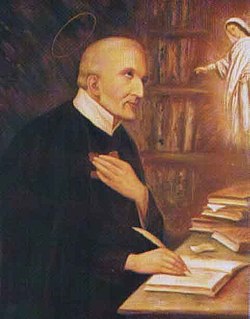
Below is a portion of Saint Alphonsus’ letter to a young man who asks council on the choice of a state of life — for all those considering a vocation to the religious life:
“I read in your letter that some time ago you felt inspired by God to become a religious, and that afterwards many doubts arose in your mind, and especially this one, that, without becoming a religious, you might sanctify yourself also in the world.
…to remain detached from earthly goods, to live a life recollected in God; and to maintain this… I will answer your letter briefly, for, should you wish to read something more complete, you can read a little work of mine, which has already been printed, under the title “Counsels concerning Religious Vocation,” in which I have treated this matter more fully. Here I will only say, briefly, that this point of the choice of a state of life is of the greatest importance, as upon it depends our eternal salvation. The greatest number of those who are damned are damned for not having corresponded to the call of God.
In order, therefore, that you may be able to choose that state, which will be the surest for attaining eternal salvation, consider that your soul is immortal, and that the only end for which God has placed you in this world was, not certainly that you may acquire money and honors on this earth, and thus live a comfortable and delightful life, but that by holy virtues you may merit eternal life, “the end is life everlasting” (Rom. 6.22). In the day of judgment it will avail you nothing to have advanced your family, and to have made a figure in the world; it will only avail you to have served and loved Jesus Christ, Who is to be your Judge.
To Sanctify Yourself
You have a thought which tells you that you will also be able to sanctify yourself by remaining in the world. Yes, my dear sir, you will be able, but it is difficult, and if you are truly called by God to the religious state, and yet remain in the world, it is, as I have said above, morally impossible, because those helps will be denied you which God had prepared for you in religion, and without them you will not save yourself. To sanctify yourself it is necessary for you to employ the means, — such as, to avoid evil occasions, to remain detached from earthly goods, to live a life recollected in God; and to maintain this, it is necessary to receive the sacraments frequently, to make your meditation, your spiritual reading, and to perform other devout exercises, everyday, otherwise it is impossible to preserve the spirit of fervor. Now, it is difficult, not to say impossible, to practice all this in the midst of the noise and the disturbances of the world; for family affairs, the necessities of the house, the complaints of parents, the quarrels and persecutions with which the world is so full, will keep your mind so occupied by cares and fears that you will barely be able in the evening to recommend yourself to God, and even this will be done with many distractions. You would wish to make your meditation, to read spiritual books, to receive Holy Communion often, to visit every day the Sacrament of the altar; but from all this you will be prevented by the affairs of the world, and the little you do will be imperfect, because it is done in the midst of a thousand distractions, and with coldness of heart. Your life will thus be always unquiet, and your death more unquiet still.
The World is a Traitor
On one side, worldly friends will not fail to inspire you with fear of embracing the religious life, as being a hard life and full of troubles. On the other, the world offers you amusements, money, and a contented life. Reflect well, and do not allow yourself to be led into error. Be persuaded that the world is a traitor that makes promises and does not care about the fulfillment of them. It offers you indeed all these earthly things, but suppose it should give them to you, could it also give you peace of soul? No, God only can give true peace. The soul is created only for God, to love Him in this life and to enjoy Him in the next, and therefore God only can content it. All the pleasures and riches of the earth cannot give true peace; nay, those who in this life abound the most with such goods are the most troubled and afflicted, as Solomon confesses who had them in abundance. “All,” says he, “is vanity and affliction of spirit” (Eccles. 1.14) . If the world, with its goods, could make us happy, the rich, the great, the monarchs, who are in no want of wealth, honors, and amusements, would be fully contented. But experience shows how it is with these mighty ones of the earth; the greater they are, the greater are the vexations, fears, and afflictions they have to suffer. A poor Capuchin lay-brother, who goes about girded with a cord over a sackcloth, who lives on beans, and sleeps in a small cell on a little straw, is more contented than a prince with all his gilded trappings and riches, who has every day a sumptuous table, and who goes half sick to bed under a rich canopy, unable to sleep on account of the anguish which drives sleep away. He is a fool who loves the world and not God, said St. Philip Neri; and if these worldlings live such an unquiet life, much more unquiet still will be their death, when the priest, at their side, will intimate to them that they are about to be chased away from this world, saying: “Depart hence, Christian soul, from this world.” (Roman Ritual: Prayers for the Dying) Embrace the crucifix, for this world is at end for you. The misery is, that they think little of God, and just as little of the next life, where they must remain forever. All, or almost all, their thoughts are given to the things of this earth, and this is the cause that their life is so unhappy, and their death still more.
The Right Choice
Nevertheless, that you may ascertain what state you ought to embrace, imagine yourself at the point of death, and choose that one which you would then wish to have chosen. Should you have erred, by neglecting the divine call, in order to follow your own inclinations, and to live with more liberty, there will then be no longer time to remedy the error. Consider that everything here below will come to an end. “The fashion of this world passeth away.”(1 Cor. 7.31) The scenes of this world must finish for each one of us. Everything passes, and death draws near, and at every step we take we approach nearer to it, and, through death, nearer to eternity. For this we are born. “Man shall go into the house of his eternity.” (Eccles.12.5) Death will be upon us when we least think of it. Alas! When death draws near, what will then appear all the goods of this world, but the unreal pageantry of theatre, — vanities, lies, and foolishness? And what profit will it then be, as Jesus Christ warns us, “if we should have gained the whole world and lost our souls?” (Mt. 16.26) It will help us only to die an unhappy death.
To Die a Happy Death
On the contrary, a young man who has left the world to give himself entirely to Jesus Christ, how contented will he feel, as he passes his days in the solitude of his cell, far from the tumult of the world and dangers of losing God, which are in the world! In the monastery he will not have the entertainments of music, theatres, and balls, but he will have God to console him and to make him enjoy peace. I mean all that peace which is possible in this valley of tears, into which every one is sent to suffer, and to merit by his patience that full peace which is prepared for him in heaven. But in this life even, far from the pastimes of the world, one loving look cast from time to time on the crucifix, one “Deus meus, et omnia,” (My God and my all), pronounced with affection, one “My God” said with a sigh of love, will console him more than all the pastimes and feasts of the world, which leave only bitterness behind them.
And if he lives content in such a life, more content will he be still at his death at having chosen the religious state. How much will it then console him to have spent his life in prayer, in spiritual reading, in mortification, and in other exercises of devotion, especially if he has been in an Order employed in saving souls by preaching and hearing confessions, — things which at his death will all increase his confidence in Jesus Christ, who is truly grateful and liberal in rewarding those who have labored for His glory!
Leave the World and give Thyself to Me
But let us come to a conclusion with regard to your vocation. Since the Lord has called you to leave the world, and to be entirely His in religion, I tell you: Rejoice and tremble at the same time. Rejoice, and on one hand, and always thank the Lord, because to be called by God to a perfect life is a grace which He does not give to all. (Ps.147.20) On the other hand, tremble, because if you do not follow the divine call, you will put your eternal salvation in great danger. It is not my intention here to relate to you the many examples of young men who, because they made no account of their vocation, have lived a miserable life and died a horrible death. Hold for certain that, as God has called you, you will never have peace, if you remain in the world; and at your death you will be very unquiet, on account of the remorse that then will torment you, for having neglected to obey God, Who had called you to the religious state.
I conclude by offering you the assurance of my respectful consideration; I pray the Lord to make you belong entirely to Himself, and remain, your very humble and very devoted servant.”

Vocational Resources
 Capuchin Sisters of St Joseph