
Dear Family, Friends, and Benefactors:
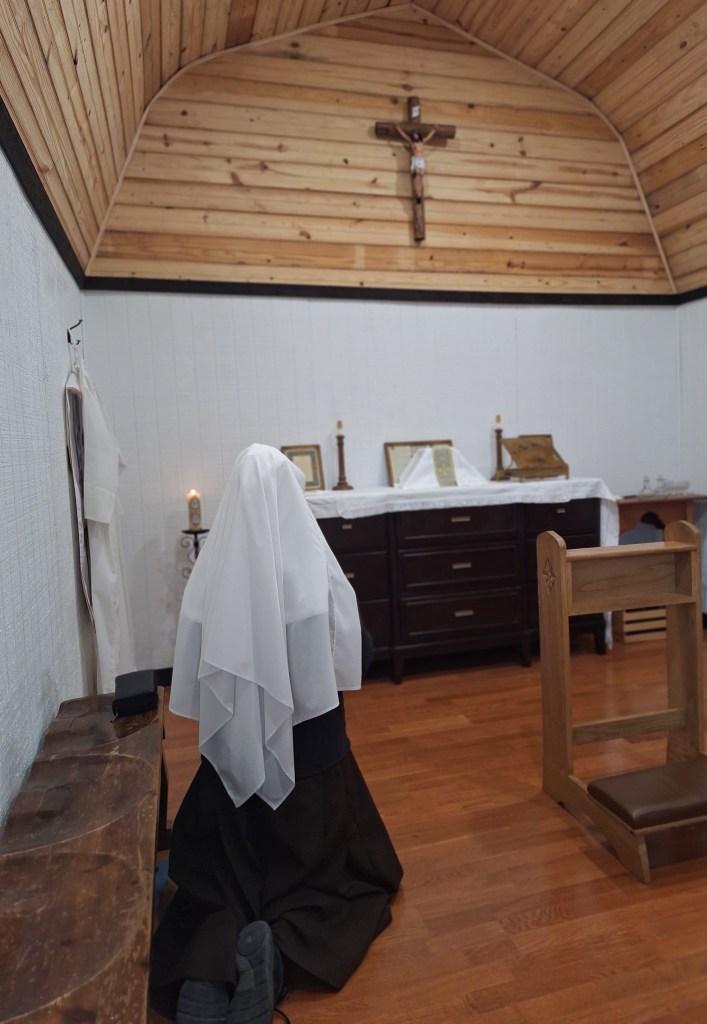
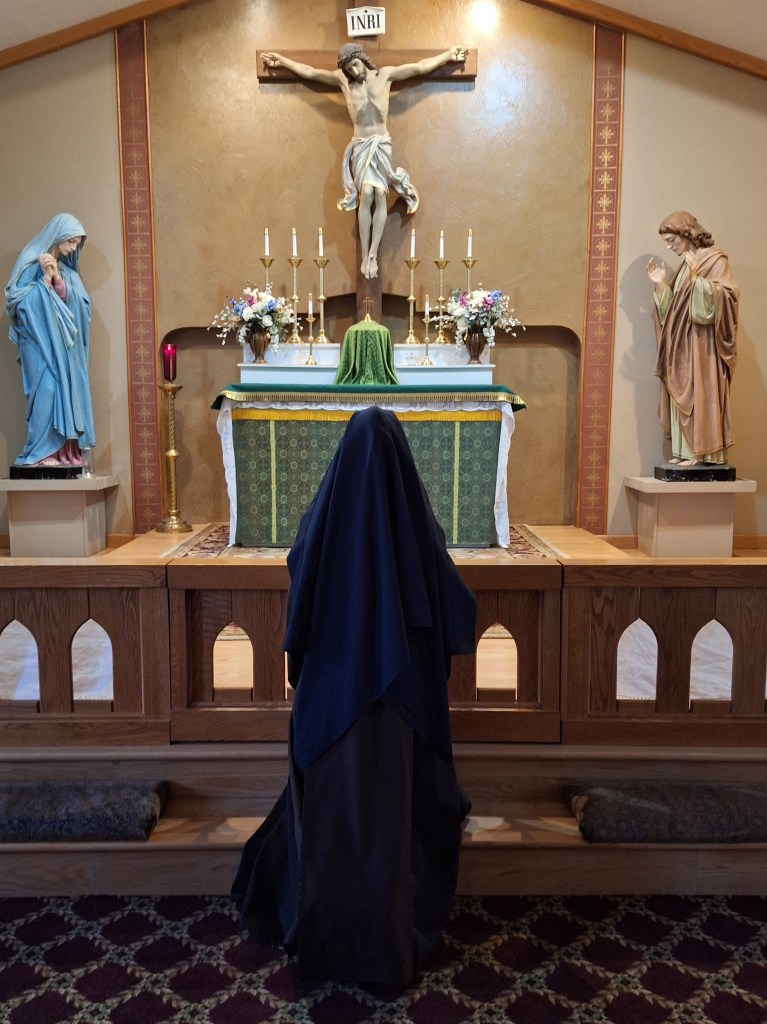
As we continue in the month of the Precious Blood, we wish to reassure each of you of your continued place in the heart of our prayers. How much we have to be grateful for in our temporary home in Colorado! For the first two years of our community, we were without a chapel except on Sundays. Far from hindering us from the practice of mental prayer and our spiritual exercises, it ignited a longing in our hearts and souls to be in the presence of our Divine Spouse before the tabernacle. During the third year of our foundation, the benefactors who provided our housing built a little chapel on their property. While we still lacked the True Presence, we were one step closer. This little chapel, “Our Lady of the Angels,” will always be very special to us. Here in Burlington, thanks be to God, our longings have been fulfilled above and beyond measure. Although it is only temporary, until our heavenly Father provides a permanent place for us, we count ourselves as the richest of the rich, as we have everything and All here in the tabernacle.
We have included with this post a short instruction on mental prayer, which has been simplified in order that, God willing, it may be of help to those who have asked for it. St. Teresa of Avila once said that no one who earnestly applies themselves to mental prayer will be lost. It was the practice of the saints, and it is in our Rule here in the convent to begin and end each day with half an hour in mental prayer.
We continue to beg for your charity in helping us to raise the necessary funds for a permanent home. Information can be found on our “Donate” link. We ask God to bless you with His promised hundredfold now and in eternity.
In the Hearts of Jesus and Mary,
Capuchin Sisters of St. Joseph
MENTAL PRAYER
All Catholics should make at least a short meditation every day. Mental prayer is a more appropriate and comprehensive term for that spiritual exercise which is so highly praised and commended by the saints and so conducive to holiness and perfection.
Mental prayer is within the reach of all who earnestly desire their salvation. In mental prayer, meditation, which is the exercise of the intellect, is only a means to the end. This end is the elevation of the soul to God or, if you will, conversation with God. While thinking and reflecting, the soul speaks to and reasons with itself. However, in the prayer that follows, the soul speaks to God.
“In mental prayer,” says St. Alphonsus, “meditation is the needle, which only passes through that it may draw after it the golden thread, which is composed of affections, resolutions, and petitions.” As soon as you feel an impulse to pray while meditating, give way to it at once in the best way you can by devout acts and petitions; in other words, begin your conversation with God on the subject about which you have been thinking.
In order to help the mind in this pious exercise, you must have some definite subject of thought upon which it is well to read either a text of Holy Scripture or a few lines out of some other holy book. Any point on the Passion of Our Lord will provide ample material for this practice.
St. Alphonsus says, “It is good to meditate upon the last things – death, judgment, eternity – but let us above all meditate upon the Passion of Christ.”
St. Teresa of Avila tells us that in her meditations she helped herself with a book for seventeen years. By reading the points of a meditation from a book, the mind is rendered attentive and is set on a train of thought. Further to help the mind, you can ask yourself some such questions as the following: What does this mean? What lesson does it teach me? What has been my conduct regarding this matter? What have I done, what shall I do, and how shall I do it? What particular virtue must I practice?
Do not imagine, moreover, that it is necessary to wait for a great fire to flame up in your soul, but cherish even the smallest spark you may have. Above all, never give way to the mistaken notion that you must restrain yourself from prayer in order to go through all of the thoughts suggested by your book, or because your prayer does not appear to have a close connection with the subject of your meditation. This would simply be to turn from God to your own thoughts or to the thoughts of another.
To meditate means, in general, nothing other than to reflect seriously upon some subject. Meditation, as mental prayer, is a serious reflection on some religious truth or event, with reference and application to ourselves, in order thereby to excite in us certain pious sentiments, such as contrition, humility, faith, hope, charity, etc., and to move our will to form good resolutions conformable to these pious sentiments. Such an exercise has a beneficial influence on our soul and greatly conduces to enlighten our mind and to move our will to practice virtue.
Meditation is a great means to salvation. It helps us to know ourselves and to discover the means of avoiding and correcting our vices, our faults, and weaknesses; it reveals to us the dangers to which our salvation is exposed and leads us to pray with a contrite and humble heart for the necessary graces to cope with temptations, to control our passions, and to lead a holy life. Mental prayer inflames our hearts with the love of God and strengthens us to do His holy will with zeal and perseverance.
We should endeavor to spend at least fifteen minutes daily in mental prayer. The saints used to spend many hours daily therein. When they had much to do, they would subtract some hours from the time allotted to their sleep in order to devote themselves to this holy exercise. If we cannot spend half an hour every day in this practice, let us at least devote to it a quarter of an hour. The longer and the more fervent our mental prayer, the more we shall enjoy it, and we shall learn by our own experience the truth of the saying of the Royal Prophet, “Taste and see that the Lord is sweet” (Ps. xxxiii. 9).
As to our petitions and resolutions, in mental prayer it is very profitable, and perhaps more useful than any other act, to address repeated petitions to God, asking with great humility and unbounded confidence for His graces, for virtues and, above all, for the inestimable gift of His holy love. If we feel dry or despondent and unable to meditate or pray well, let us repeat many times as earnestly as possible, “My Jesus, mercy!”, “My God, I love Thee!” or any ejaculatory prayer. This will be very meritorious.
Let us offer all our petitions for grace in the Name and through the merits of Jesus Christ, and we shall surely obtain all that we ask.
Before concluding the meditation, we should make some specified good resolution, appropriate as far as possible to the subject of our meditation. This resolution should be directed to rooting out of a particular sin, or of some occasion of sin, to the correction of some defect, or to the practice of some act of virtue during the day.
The preparation of our meditation consists of (1) an act of faith in the presence of God, and of adoration; (2) an act of humility and of contrition, and (3) an act of petition for light. We should then recommend ourselves to the Blessed Virgin Mary by reciting a Hail Mary, and also to St. Joseph, to our Guardian Angel, and to our holy patrons. These acts should be brief but very fervent.
The conclusion of our meditation consists of (1) thanksgiving to God for the light He imparted to us; (2) purposing to fulfill our good resolutions at once; and (3) beseeching the eternal Father, for the love of Jesus and Mary, to grant us the grace and strength to put them into practice. Before finishing our meditation, let us never omit to recommend to God the souls in purgatory and poor sinners.
 Capuchin Sisters of St Joseph
Leave a comment