
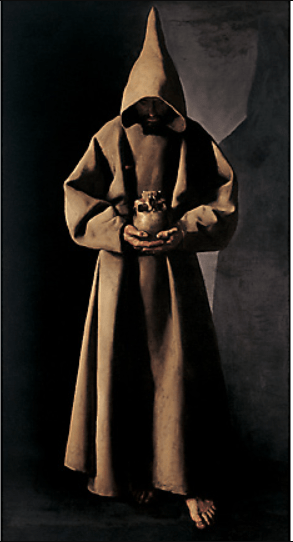
(By an anonymous 16th century Franciscan Friar)
On Ash Wednesday, the narrow path officially begins with the imposition of the blessed ashes. By imprinting them on our foreheads, the Church repeats over each of us, as a reminder, the sentence that God once pronounced over Adam: “Remember, man, that thou art dust and into dust thou shalt return.”
Remember. Don’t be forgetful; don’t try to forget.
Remember, and don’t let the pleasures and attractions of this world distract your mind from your innermost reality.
Remember that you were not born of yourself and that you were taken from the dust of the earth.
Remember that nothing you have is truly yours and that you will have to answer for what you have done with it.
Remember that day when you will give an account of your entire life.
Remember that you have an immortal soul, but your body will dissolve into decay.
Remember that the only thing that makes you acceptable to God is your good works.
Remember the statement of your divine Redeemer:”…they that have done good things shall come forth unto the resurrection of life; but they that have done evil, unto the resurrection of judgment.”
Remember it, and don’t think you can change it.
Remember that one day you will die, and if you haven’t worked hard for your salvation, you will have lost everything.
Remember the strict relationship between your behavior and your eternity.
Remember that there are two paths: one wide and fun that leads to perdition and one narrow and arduous that leads to eternal life.
Remember that God placed His very Life in your hands so that you may make It the center of your life.
Remember that God is waiting for you to be saved, not to follow the path of those who do not know Him.
Remember the Laws of God and follow them, and you will secure your eternal destiny.
Remember the examples that God set for you, some to teach others a lesson and others to imitate.
This is also part of the teaching of the Catholic Church.
Remember your catechism, and adjust your life to it; nothing will be more beneficial to you in this life.
Remember that you were not born for yourself, but for others.
Remember that your neighbor is the image of God.
Remember that you have the image of God within yourself, to cultivate and develop it through charity.
Remember that you can deceive yourself, and do not listen to yourself, but seek advice in every situation.
Remember that the most pleasing offering you can make to God is to acknowledge your inherent insufficiency and your need for Him.
Remember that there are things to love and things to use; things from heaven to love and things from earth to use. Heavenly things are the end; earthly things are the means to achieve them.
We could endlessly continue the list of “remembers” going through all the points of Catholic doctrine, and each one of us could do the same for our own personal use, which would be very good because, when our mind and heart are occupied with heavenly things, they are in their own element. The Catholic Church, faithful to the task entrusted to it by its divine Founder, desires to structure our minds during Lent into two main points. Our task, on the other hand, is to understand this structure, accept it, and assimilate it. These are three necessary steps for progress in our Catholic life: to know, to accept, and
to assimilate.
Progress means going from good to better. The Italians have a saying that goes, “the same as before, worse than before.” If we reach a certain age where we consider ourselves adults and continue with the same old vices, we have that case: we are worse than before because we are spiritually stagnant, our spiritual life has not developed, it does not exist. Oh, miserable human condition! All this can happen to us even if we attend Mass, pray the Rosary, and wear the Brown Scapular. However, the eternity of our soul is our hope, since every moment of our life is unique, eternal, and therefore redeemable. It is enough
that we adapt ourselves, not only in our behavior, but also in our understanding and our desires, to what the Catholic Church teaches us. One of our greatest obstacles is truly coming to recognize ourselves as our own worst enemies. The more we listen to ourselves, the less we are able to listen. The two points that the Church desires to emphasize during Lent are the need to take take the narrow path and the hope of achieving the eternal reward through our cooperation in our own redemption.
Hence, Lent can be seen as the ideal of Catholic life and as a reminder of eternal life. From the first point of view, the Church teaches us that if we want to reach heaven or understand and love God more, we must put aside some things. In this case, She simply reminds us of the essential doctrine of life: “I am delighted with the law of God, according to the inward man: But I see another law in my members, fighting against the law of my mind and captivating me in the law of sin, that is in my members. Unhappy man that I am, who shall deliver me from the body of this death?” Or, “They who are in the flesh cannot
please God.” Or, “If I yet pleased men, I should not be the servant of Christ”.
The other point on which the Church wants us to stand firm is the certainty of eternal life and our aspiring to it. Thus, Lent is presented to us as a reminder of our temporary life, which passes and will never return, and Easter is presented to us as a reminder of eternal life. From this point of view, our attention is focused on what we must do, and from the second point of view it is focused on what we expect. Let us not fail to do what is our responsibility as children of God and of the Catholic Church, and let us always aspire to the best.
May the Blessed Virgin Mary, Mediatrix of all grace, teach us this path of strength and wisdom.
 Capuchin Sisters of St Joseph
Leave a comment