
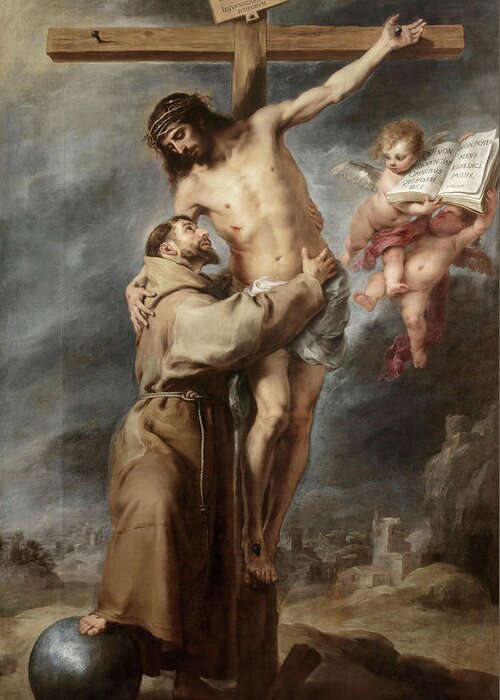
Perhaps the greatest treasure of the Franciscan Order is the stigmata of our Holy Father, St. Francis. He was the first saint to receive the wounds of Christ. The manner in which he received them and the significance of their reception remind us of what we strive for during the holy season of Lent.
The Cross and Our Crucified Lord were the objects dearest in the heart of St. Francis. As Johannes Jorgensen writes: “It was the voice of the Cross that in San Damiano’s lonely church in 1207 had converted him from the world to follow Christ in naked poverty. ‘From that hour,’ says the Three Brothers’ Legend, ‘his heart was so sore and melted with the memory of Christ’s sufferings, that all his life he bore the wounds of the Lord Jesus in his heart.’” – (JJ)
St. Francis Receives the Stigmata
St. Francis left for Mt. La Verna in August of 1224. He wished to celebrate the Assumption of the Blessed Virgin Mary there and then prepare himself by a forty days’ fast for the feast of St. Michael (September 29), to whom St. Francis had a great devotion. While there, St. Francis reminded the brothers with him how they were to live. Jorgensen writes: “And after many beautiful and pious words about this thing [the virtue of poverty], he concluded, saying: ‘This is the way of life I lay upon you and myself. For as I see that my death approaches, I wish to be alone with God and lament my sins. And Brother Leo can bring me a little bread and a little water, as seems fit to him, but if anyone comes, answer for me, and let no one come to me!’” – (JJ)
During this time, St. Francis became sad and disquieted with thoughts of the future. “In vain did Francis issue his Ideal Image of what a perfect Friar Minor, a perfect Provincial Minister, a perfect General of the Order, should be — he knew well that the facts were widely different. Brother Elias and others of his mind were not, as Francis would have it, satisfied with ‘a book and an ink-horn and one pen and a signet,’ — they collected books and studied church law, and it was only waste of time to exhort them to act towards their Brothers in the spirit not in the letter of the law.” This caused him tremendous suffering. “They had taken his Brothers, his sons, from him, and whither were they taking them now? They were going where Francis did not wish them to go, and he had to look on without power.” – (JJ)
In order to obtain help, St. Francis asked Br. Leo to open the Gospels three times, and each time he opened to the Passion of Christ. By this, St. Francis understood he was to suffer and resign himself to the will of God. He spent his days contemplating the Cross and the unsurpassed suffering and love of Christ. With this subject in mind, “Francis lay in prayer outside his cell on the morning of the fourteenth of September. It was not yet day, but while awaiting the sunrise he prayed, with face turned to the east, with hands upraised and extended arms:
“O Lord Jesus Christ, two favors I beg of thee before I die. The first is, that I may, as far as it is possible, feel in my soul and in my body the suffering which thou, O gentle Jesus, sustained in thy bitter passion. And the second favor is, that I, as far as it is possible, may receive into my heart that excessive charity by which thou, the Son of God, wast inflamed, and which actuated thee willingly to suffer so much for us sinners.”
(JJ)
“And as he long prayed thus,” say the Three Brothers, “he felt a certainty that God would vouchsafe him these two things, and that it would be given him to receive both parts, so far as it was possible for a creature… and the glow of piety grew so strong in him, that with charity and pity he was all transformed to Jesus.” – (JJ)
Jorgensen concludes: “And as he lay in this prayer… behold, it came to pass that he… saw a seraph coming down from heaven with six luminous wings. And the seraph slowly approached Francis, so that he could discern and clearly see that it bore an image of a crucified man, and its wings were so placed that two were raised over the head, two were extended for flight, and with two it covered its body.” – (JJ)
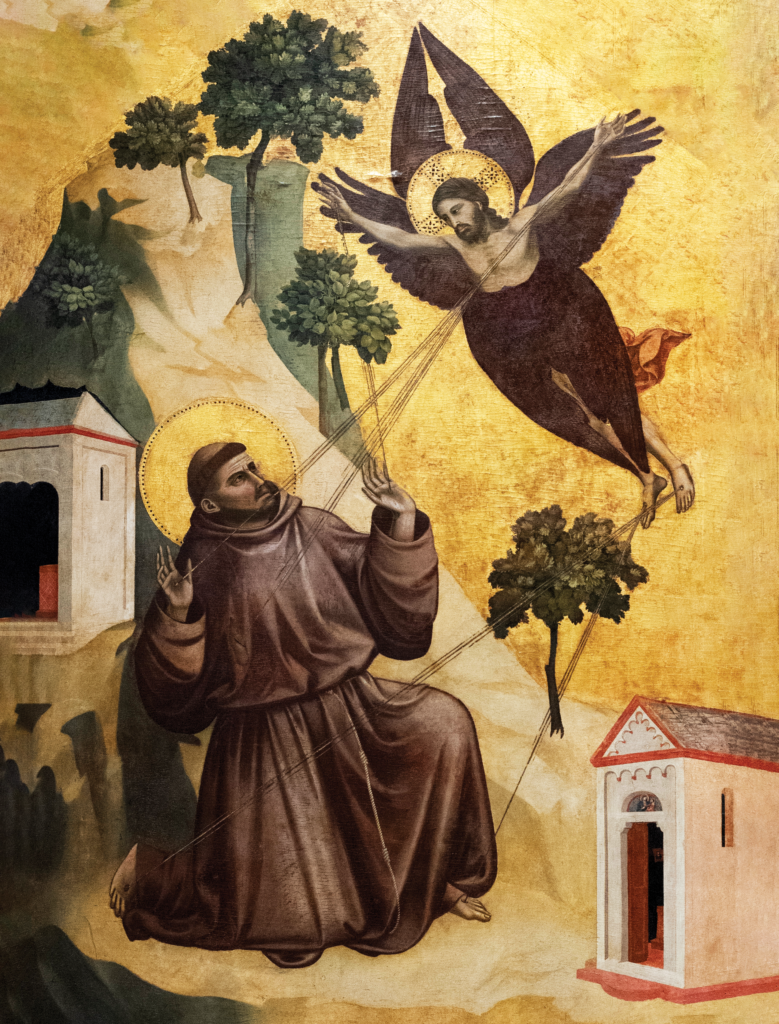
“But when Francis saw this vision he was much frightened, and at the same time he was filled with joy and sorrow and wonder. For he had great joy in the gentle Jesus who showed Himself to him so intimately and looked so lovingly upon him, but it gave him inexpressible sorrow to see the Lord fastened to the Cross. And, moreover, he wondered over so unusual and astonishing a vision, for he knew that mortal suffering is not compatible with a seraph’s immortal spirit. But as he wondered thus, it was revealed to him by the one before him that this vision by a special provision of God was granted him that he should understand that it was not by bodily martyrdom, but through an inner flame, that he should be transformed entirely into the likeness of Christ the Crucified.” After the vision had disappeared, “an excessive glow was left in Francis’ heart, and a living love of God, and in his body the vision left a wonderful image and imprint of Christ’s sufferings.” – (JJ)
The Significance of the Stigmata of St. Francis
4 things were significant about the stigmata of St. Francis:
- It was God’s seal on the Order of St. Francis
- It showed St. Francis’ perfect conformity to Christ
- It was the renewal of the Passion of Christ
- It served and serves as a reminder for all
God’s Seal
By bestowing upon St. Francis His Sacred Wounds, Our Lord Jesus Christ showed his approval of St. Francis’s way of life. It was Christ Himself who wrote the Rule of the Friars Minor, as Br. Leo related: “And then all heard the voice of Christ in the air, which said: ‘Francis, there is nothing in the Rule of thine, but it is all Mine…” – (JJ Bk. 3 Ch. 11)
St. Francis’ Conformity to Christ
“After the said seraphic apparition, Christ, who then appeared to him, spoke to St Francis certain high and secret things which he would not reveal during his lifetime to anyone ; but after his life was ended he revealed them, as will be shown further on ; and these were his words : ” Knowest thou what I have done unto thee? I have given thee the stigmas which are the signs of My Passion, because thou shalt be My ambassador. And even as I on the day of My death descended into Limbo and delivered all the souls I found there, by virtue of My wounds, so also do I grant to thee that every year on the anniversary of thy death thou shalt go to purgatory, and all the souls thou shalt find there of thy three orders, namely of the Friars Minor, of the sisters and virgins, and of the others also who shall have remained sincerely devoted to thee, thou shalt deliver by virtue of these thy stigmas, and shalt lead them into the glories of paradise, that so thou mayest be conformed to Me in thy death as thou hast been in thy life.” – (F); The Third Consideration of the Holy Stigmas
Renewal of the Passion
“And after some days, as St Francis was standing by his cell considering the conformation of the mountain and marveling at the immense fissures and apertures in the great rocks, it was revealed to him by God while he prayed that these mighty chasms had been miraculously opened in the hour of the Passion of our Lord when, as the evangelist relates, the rocks were rent asunder. And it was the will of God that this should more particularly take place in this mountain of Alvernia, because the Passion of our Lord Jesus Christ should there be renewed in the soul of St Francis by loving compassion, and in his body by the sacred stigmas.” – (F); The Second Consideration of the Holy Stigmas
A Reminder for All
The holy stigmata is a reminder to us, as it was a reminder to the people of Assisi, the reality of the suffering and charity of Our Lord, Jesus Christ.
“But for all his pains to hide the sacred mystery of the holy stigmas in order to fly the occasion of earthly glory, it pleased God, for His own glory, to show forth many miracles by virtue of them;… both during his life and after his glorious death, in order that by these clear and evident miracles the hidden and marvelous virtue of the most holy stigmas, and the excessive charity and mercy of Christ so wonderfully shown in his regard might be manifested to the world.” – (F); The Fourth Consideration of the Holy Stigmata
Miracles of the Stigmata
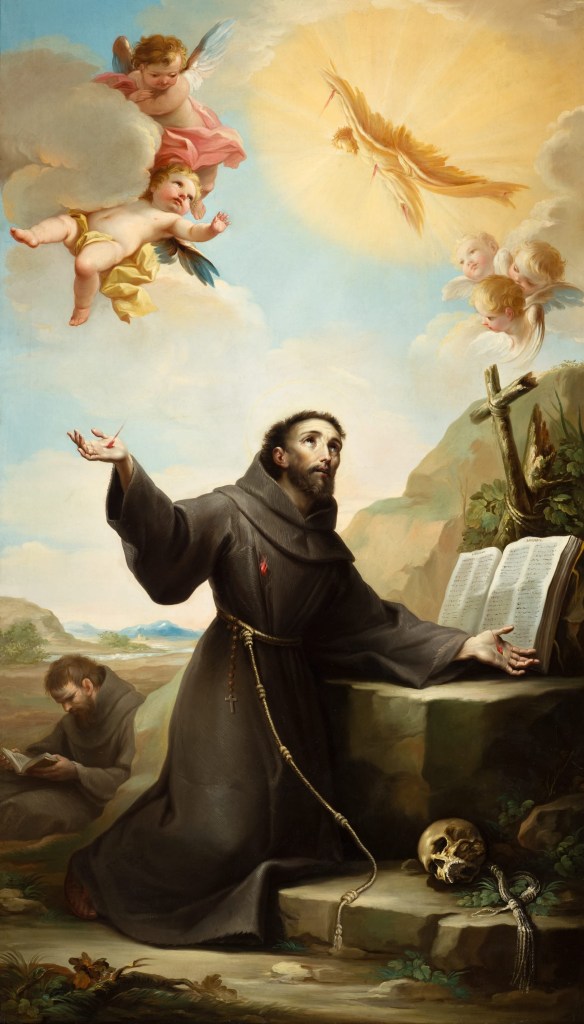
There are numerous miracles in virtue of the holy stigmata of St. Francis, many of which can be found in the Fioretti. We will only describe two here.
Warming a Freezing Peasant
While traveling from Alvernia to Our Lady of the Angels with Br. Leo and a pious peasant who lent his donkey for St. Francis to ride, the weather became so terrible they were unable to reach their destination before nightfall. They were obliged by the dark and a snowstorm to find shelter in a hollow cave. They had no means to make a fire, and the poor peasant could not sleep from the cold.
He started to complain bitterly and to murmur against St. Francis who brought him there. St. Francis perceived this and, in his fervent charity, extended his hand, touching the peasant’s own. At once it was seared with seraphic fire, the cold was driven away, and the man experienced such warmth in front of him and behind him that it seemed he was in a furnace. He was comforted in body and soul and stated the next morning that he slept more sweetly in the rocks and snow than he ever did in his own bed.
A Vision of a Dead Brother Released from Purgatory
It happened once that a devout Brother heard that another Brother, and his companion, had died during the night. He prayed in the choir until midday with fervor and tears when suddenly there was a great noise. He saw St. Francis and other brothers standing at the entrance of the choir. He then saw Our Lord with a multitude of saints walking around the choir. Finally, he saw in the cloisters the soul of his companion in flames.
St. Francis knelt and implored Our Lord Jesus Christ twice to release the soul of the Brother from purgatory in virtue of His Incarnation and Death on the Cross, but Christ continued to walk as if He did not hear. Finally, St. Francis knelt a third time and showed Christ the stigmata saying, “I pray Thee, most compassionate Father and Lord, by the great pains and great consolation which I sustained when Thou didst impress these stigmas on my flesh, that Thou wouldst have mercy on the soul of my brother that is in this fire of purgatory.”
At once Our Lord stood still beside St. Francis and said: “Francis, to thee I concede the soul of thy brother.” And by this He certainly wished to honour and confirm the glorious stigmas of St Francis…
References
- The Biography of St. Francis written by Johannes Jorgensen, Bk 4 Ch 4 (JJ),
- The Legend of the Three Brothers (L), which was referenced by Jorgensen
- and The Fioreti (F).


Leave a comment