

St. Clare of Assisi
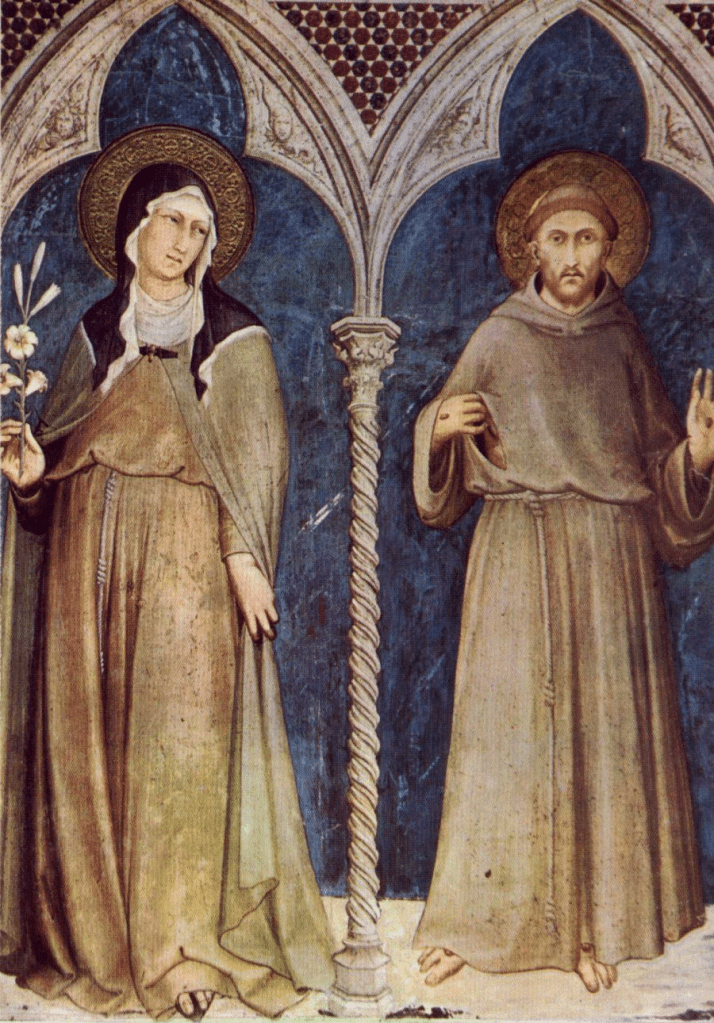
At the beginning of the thirteenth century when luxury and sensuality held sway, St. Francis of Assisi made his appearance, giving to men the example of a poor and penitential life. But God wished also to give the vain and pleasure-loving women of that period an example of contempt of the world’s vanities. For this mission He chose Clare, the daughter of a prominent and noble family of Assisi, born on January 20, 1194. Her father was favarone de Offreduccio, count of Sassorosso; her mother, the servant of God Ortolana, who died in the odor of sanctity. [1] St. Francis inaugurated his work, as Dominic had done, by preparing a dwelling for his future daughters, whose sacrifice might obtain every grace for the great Order he was about to found. [2]
Before the child’s birth it was revealed to the mother that her offspring would be a brilliant light in the world. This light the mother detected in her daughter from her earliest years. Besides being favored with personal beauty, Clare possessed a charming personality and rare qualities of mind. She was a favorite in the family, and hardly had she attained to young womanhood, when several suitors sought for her hand in marriage.
But her virtues surpassed the gifts with which nature endowed her. She interested herself in the poor and frequently denied herself things so as to be able to give more to the poor members of Christ. She loved prayer, and it was her sweetest delight to surrender her heart to sentiments of ardent devotion before Jesus Christ in the Blessed Sacrament. Beneath her beautiful garments she wore a sharp penitential belt in order to honor the sufferings of Christ and to preserve herself a chaste virgin for His sake.
She was eighteen years old when she heard St. Francis preach in the Cathedral of Assisi during the Lent of 1212. His words on contempt of the world and on penance, and particularly the holy example he set earnestly affected Clare, that she conferred with him and soon recognized that God was calling her to lead a life similar to his in the seclusion of the convent. She did not hesitate to carry out God’s plans. Realizing that her family, intent only on a brilliant future for her in the world, would oppose her vocation in every way, she had to leave home in secret.
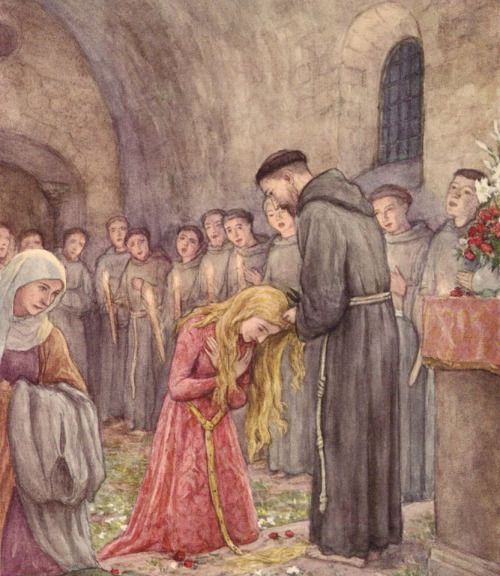
On Palm Sunday she went to church, dressed in her richest garments, to attend divine services. That night, attended by an elderly relative, she went to the little chapel of St. Mary of the Angels, Where St. Francis and his brethren came to meet her with lighted candles in their hands. Before the altar she removed her beautiful headdress, then St. Francis cut off her hair and covered her head with a veil of common linen. In place of rich garments, she received a coarse penitential garb and was girded with a white cord. This was the way in which the mother and founder of the Poor Clares was invested on March 18, 1212. For the time being, St. Francis placed her in a convent of Benedictine Sisters.
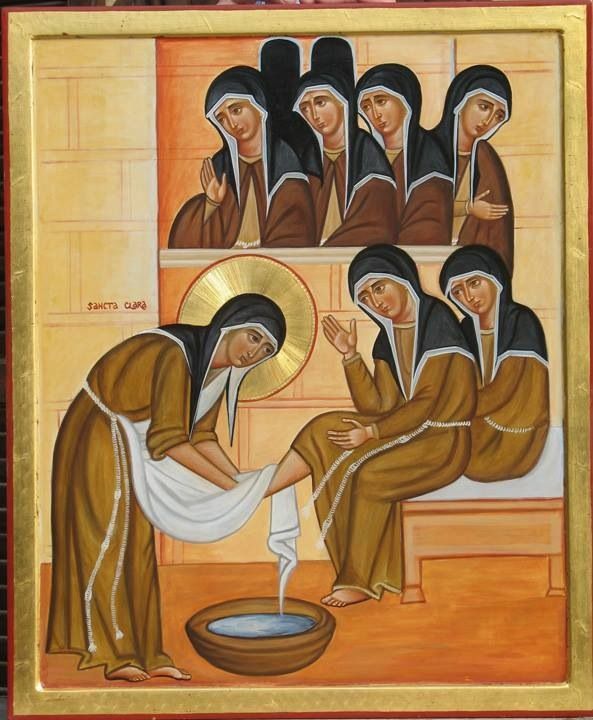
When Clare had successfully overcome the great opposition of her family, who had intended to force her to return home, her sister Agnes joined her in her sacrifice. St. Francis arranged a little convent for them near the church of St. Damian. There the number of consecrated virgins soon increased. They served God in great poverty, strict penance, and complete seclusion from the world according to a rule which St. Francis gave them as his Second Order. Clare was obliged under obedience to accept the office of abbess in 1215 and to continue in it for thirty-eight years until her death. But her love for humility found compensation in the performance of the lowliest services toward her sisters. In spite of her great physical sufferings, she set her sisters a striking example of zeal in penance and prayer. [3]
Clare was to Francis the help like unto himself, who begot to the Lord that multitude of heroic virgins and illustrious penitents soon reckoned by the Order in all lands, coming from the humblest condition and from the steps of the throne. In the new chivalry of Christ, Poverty, the chosen Lady of St. Francis, was to be the queen also of her whom God had given him as a rival and a daughter. Following to the utmost limits the Man-God humbled and stripped of all things for us, she nevertheless felt that she and her sisters were already queens in the kingdom of heaven: (Regula Damianitarum, viii); In the little nest of poverty,” she used to say, “what jewel could the bride esteem so much as conformity with a God possessing nothing, become a little One whom the poorest of mothers wrapped in humble swathing bands and laid in a narrow crib?” And she bravely defended against the highest authorities the privilege of absolute poverty, which the great Pope Innocent III feared to grant. Its definitive confirmation, obtained two days before the Saint’s death, came as the long-desired reward of forty years of prayer and suffering for the Church of God… For forty-two years she ruled her monastery with wonderful care and prudence, in the fear of God and the full observance of the Rule. Her own life was a lesson and an example to others, showing all how to live aright.
She subdued her body in order to grow strong in spirit. Her bed was the bare ground, or, at times, a few twigs, and for a pillow she used a piece of hard wood. Her dress consisted of a single tunic and a mantle of poor coarse stuff; and she often wore a rough hair-shirt next to her skin. So great was her abstinence, that for a long time she took absolutely no bodily nourishment for three days of the week, and on the remaining days restricted herself to so small a quantity of food, that the other religious wondered how she was able to live. Before her health gave way, it was her custom to keep two Lents in the year, fasting on bread and water. Moreover, she devoted herself to watching and prayer, and in these exercises especially she would spend whole days and nights. She suffered from frequent and long illnesses; but when she was unable to leave her bed in order to work, she would make her sisters raise and prop her up in a sitting position, so that she could work with her hands, and thus not be idle even in sickness.
The greatness of her sanctity was manifested by many different miracles. She restored the power of speech to one of the sisters of her monastery, to another the power of hearing. She healed one of a fever, one of dropsy, one of an ulcer, and many others of various maladies. She cured of insanity a brothers of the Order of Friars Minor. Once when all the oil in the monastery was spent, Clare took a vessel and washed it, and it was found filled with oil by the loving kindness of God. She multiplied half a loaf so that it sufficed for fifty sisters. [4]
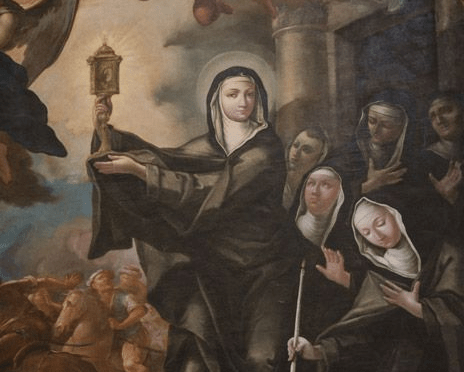
In the year 1240 an army of Saracens who were in the service of the excommunicated Emperor Frederick II drew near Assisi. They rushed upon the little convent of St. Damian that lay outside the city and had already scaled the walls of the monastery. In mortal fear the sisters had recourse to their mother, who was ill in bed.
The saint, carrying the pyx containing the Most Blessed Sacrament had herself carried to a convent window. There she pleaded fervently with the Lord of heaven in the words of the Psalmist (Ps. 73:19), “Deliver not up to beasts the souls, that confess to Thee, and shield thy servants whom thou hast redeemed with Thy precious blood.” A mysterious voice coming from the host said: “I shall always watch over you.” Immediately panic seized the besiegers. A ray of brilliant light which emanated from the Blessed Sacrament had dazzled them. They fell down from the walls and fled from the place. The convent was saved and the town of Assisi was spared. [5]
From the ancients of Israel, there came to this virgin, not yet thirty years old, such messages as this: “To his very dear Sister in Jesus Christ, to his mother the Lady Clare, handmaid of Christ, Hugolin of Ostia, unworthy bishop and sinner. Ever since the hour when I had to deprive myself of your holy conversation, to snatch myself from that heavenly joy, such bitterness of heart causes my tears to flow, that if I did not find at the feet of Jesus the consolation which his love never refuses, my mind would fail and my soul would melt away. Where is the glorious joy of that Easter spent in your company and that of the other handmaids of Christ? … I knew that I was a sinner; but at the remembrance of your supereminent virtue, my misery overpowers me, and I believe myself unworthy ever to enjoy again that conversation of the Saints, unless your tears and prayers obtain pardon for my sins. I put my soul, then, into your hands; to you I entrust my mind, that you may answer for me on the day of judgment. The Lord Pope will soon be going to Assisi; Oh! that I may accompany him, and see you once more! Salute my sister Agnes (i.e. St. Clare’s own sister and first daughter in God); salute all your sisters in Christ.”
The great Cardinal Hugolin, though more than eighty years of age, became soon after Gregory IX. During his fourteen years’ pontificate, which was one of the most brilliant as well as most laborious of the thirteenth century, he was always soliciting Clare’s interest in the perils of the Church, and the immense cares which threatened to crush his weakness. For, says the contemporaneous historian of our Saint, Luke Wadding: “He knew very well what love can do, and that virgins have free access to the sacred court: for what could the King of heaven refuse to those, to whom he has given himself?” [6]
After suffering from a serious illness for thirty years, Clare felt that her end was drawing nigh [7]. Her daughters beheld wings of fire over her head and covering her shoulders, indicating that she to had reached seraphic perfection. On hearing that a loss which so concerned the whole Church was imminent, the Pope, Innocent IV, came from Perugia with the Cardinals of his suite. He imposed a last trial on the Saint’s humility, by commanding her to bless, in his presence, the bread which had been presented for the blessing of the sovereign Pontiff; heaven approved the invitation of the Pontiff and the obedience of the Saint, for no sooner had the virgin blessed the loaves than each was found to be marked with a cross [8]. After she had received the last sacraments, she and one of her sisters beheld the Queen of Virgins coming with a large escort to meet her, the spouse of Jesus Christ. On August 11, 1253, she entered into the joys of eternity, and on the following day her body was buried. Pope Alexander IV canonized her already in the year 1255. [9]
Sources
[1], [3], [5], [7], and [9] – Habig, Marion A. The Seraphic Order: A Traditional Franciscan Book of Saints. Mediatrix Press, 2020
[2], [4], [6], and [8] – https://www.facebook.com/permalink.php?story_fbid=pfbid02BH1g3N2YDJwsGwYbuvv2BGU9QYn1kTETTWTGG1arYFphGhzd884hHy9oScYKMiDbl&id=100077721485830


Leave a Reply